

The Rise of the AI Phone: Ushering in an Era of Intelligent Hardware
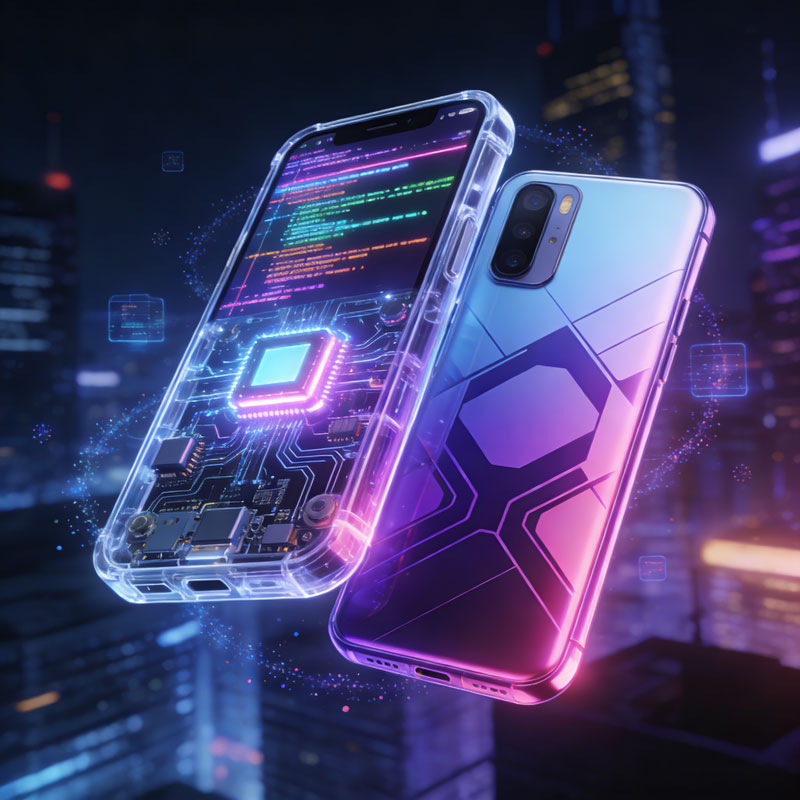
In 2025, the consumer electronics industry is experiencing significant divergence. Hardware innovation is gradually approaching physical and cost limits, while Artificial Intelligence (AI) technology is becoming the core driver of industry growth. Foldable phone prices have fallen below the 6,000-yuan threshold, hundred-watt fast charging has become standard on thousand-yuan phones, and image sensor sizes are approaching professional camera levels. These phenomena indicate that competition in the traditional hardware domain has entered a red ocean stage. Simultaneously, AI phones and various AI hardware products are demonstrating strong performance in shipments, user attention, and ecosystem development, forming a stark contrast.
Behind this industry transformation lie multiple shifts in technology, demand, and industrial logic. On-device large language model technology is progressing from “usable” to “practical.” Mainstream AI phones are now capable of locally and smoothly running models with 7 billion parameters. User demand is shifting from basic functions to a pursuit of “precise services” and “proactive intelligence.” The marginal returns from hardware innovation continue to decline, prompting companies to view AI as the key path to breaking through development bottlenecks. This shift is driving the industry’s competitive focus away from hardware performance upgrades and towards system-level reconstruction centered on AI.
The development path for AI phones is becoming increasingly clear, moving from optimizing single-point functions to deep reconstruction of the underlying system. Industry consensus has evolved from “phone + AI” to “AI phone.” AI technology is no longer an add-on feature but is deeply integrated into the operating system and hardware architecture itself. A senior executive from a leading manufacturer noted that as the hardware spec race hits a ceiling, AI has become one of the few sectors with immense remaining growth potential. Technological breakthroughs and ecosystem collaboration are jointly propelling this process. AI companies, represented by Doubao, are engaging in deep cooperation with smartphone manufacturers to address persistent issues like fragmented functionality and stuttering user experience.
Despite the broad market prospects, the widespread adoption of AI phones still faces multiple challenges. Some users perceive current AI features as lacking practical value, indicating a disconnect between innovation and demand. Ecosystem compatibility issues are particularly prominent. One deeply AI-integrated phone previously encountered market resistance due to incompatibility with mainstream applications. Industry experts point out that this is essentially a battle between ecosystems. The AI-native system’s reconstruction of interaction processes inevitably clashes with the existing internet ecosystem. Jiang Yuchen, OPPO’s Director of R&D, believes that current AI phones are still in a technological “intermediate state.” A true breakthrough requires a complete disruption of existing interaction methods.
According to the latest news, Market data confirms the strong momentum of AI phone development. In 2025, shipments of AI phones in China are expected to exceed 118 million units, accounting for an estimated 40.7% of the overall smartphone market—a penetration rate nearly double that of the previous year. The focus of technological competition has shifted towards on-device optimization, privacy computing, and the construction of intelligent agent ecosystems. For instance, one manufacturer’s product, through a model of “core agent and ecosystem agent collaboration,” is beginning to change the shopping process. Concurrently, innovation in phone form factors continues to advance. Honor has announced it will launch a Robot Phone, integrating AI, embodied intelligence, and high-definition camera technology, at CES 2026.
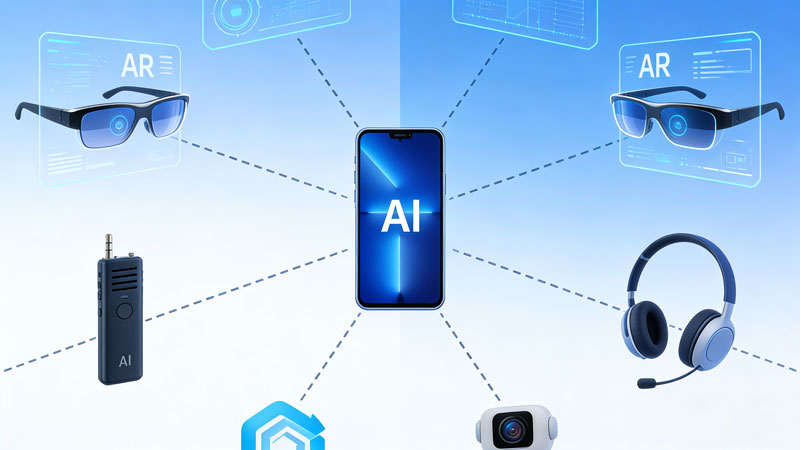
AI technology is comprehensively penetrating vertical hardware fields, driving the industry towards an ecosystem-oriented evolution. In 2025, the market size for AI hardware (excluding phones and automobiles) in China is projected to surpass one trillion yuan, with smart glasses emerging as the category with the most explosive potential. In the first half of this year, global shipments of smart glasses reached 4.065 million units, a year-on-year increase of 64.2%. Technological breakthroughs and cost reductions are the primary drivers. Models with tens of billions of parameters can now run smoothly on specialized chips, and the mass production cost of AR optical solutions has decreased by over 40% in two years, making thousand-yuan-level smart glasses a reality.
Ecosystem giants are accelerating their deployment in the smart glasses market, with companies like Li Auto and Xiaomi successively launching products. However, industry homogenization issues are gradually becoming apparent. An executive from an ODM factory revealed that approximately 90% of participants in the market are using similar solutions, making differentiation difficult. Other AI hardware sectors are exhibiting diversified innovation: AI voice recorder cards enable real-time transcription and intelligent summarization; clip-on earphones are upgraded into intelligent terminals through device-cloud collaboration; and AI earphones with cameras optimize the experience in sports scenarios. Companies universally emphasize that differentiated innovation is the key to creating genuine user value.



Related Articles
Lorem ipsum dolor sit amet
Lorem ipsum dolor sit amet consectetur adipiscing elit. Quisque faucibus ex sapien...
Lorem ipsum dolor sit amet
Lorem ipsum dolor sit amet consectetur adipiscing elit. Quisque faucibus ex sapien...
Découvrez le monde passionnant de Nine Casinos : votre guide complet
Le secteur des casinos en ligne ne cesse de croître, offrant aux...
Découvrez comment la technologie révolutionne l’expérience des casinos en ligne
Avec plus de 60 % des joueurs français qui préfèrent désormais jouer...