

AI Giants Compete for Interns with $18.3K Monthly Pay
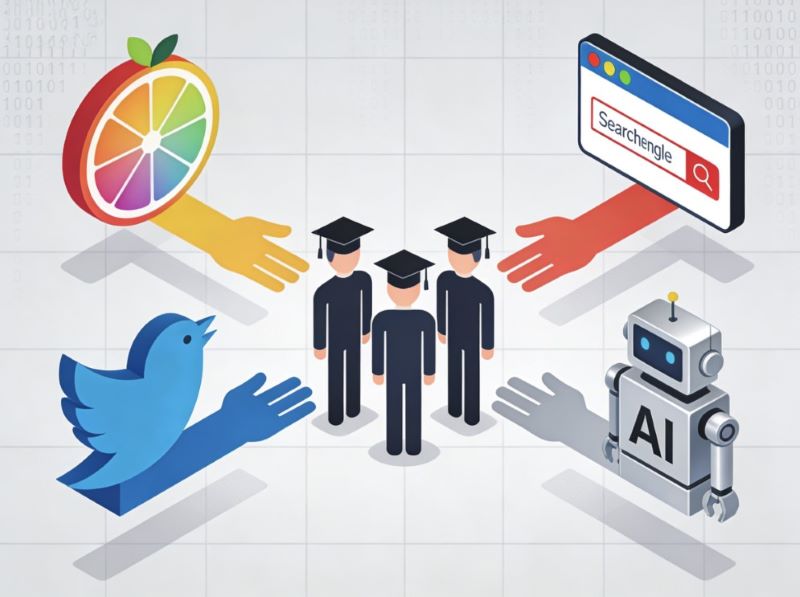
The race for AI talent has now extended to internships. Once reserved for top researchers and engineers with annual salaries of $300,000 to $400,000, or even through multi-billion-dollar investments and acquisitions to poach entire teams, leading AI companies including OpenAI, Anthropic, Meta, and Google DeepMind are shifting their competitive focus to internship and residency programs.
Gone are the days of “low-cost internships” as compensation for short-term, entry-level roles now matches full-time positions in many industries. The highest monthly salary offered to AI interns by these giants has reached $18,300, marking a significant shift in how the industry attracts and nurtures emerging talent.
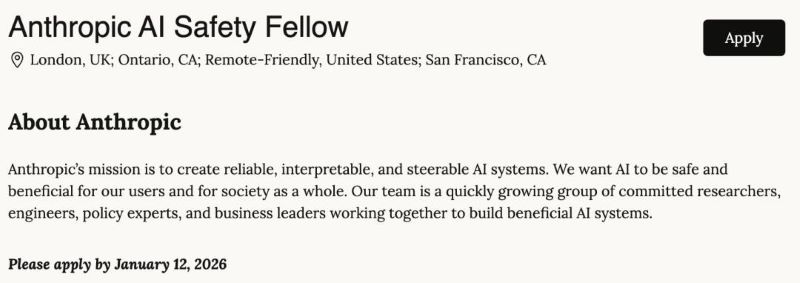
Anthropic AI Safety Fellowship
Anthropic has launched a four-month full-time research Fellowship program aimed at accelerating AI safety research and cultivating related talent. Its core objective is to enable Fellows to produce publicly publishable AI Safety research outcomes, with over 80% of previous participants successfully authoring papers, according to the company.
The program focuses on key AI Safety areas including interpretability, model alignment, and robustness—signature domains for Anthropic. It encourages participants to conduct research that can impact both industry and academia, rather than “internal-only engineering experiments.”
The mentor team features prominent AI researchers such as Jan Leike, Sam Bowman, Sara Price, Alex Tamkin, and Nina Panickssery. Fellows will collaborate closely with these experts in small groups to develop projects, discuss solutions, and refine papers, creating opportunities for future academic cooperation and career advancement.
Participants receive a weekly stipend of $3,850 plus an additional $15,000 per month in computing power funding for training and experiments—a critical resource for large model and interpretability research. The program accepts applications until January 12, 2026, with work locations available in Berkeley (U.S.) or London (U.K.). Applications can be submitted via the provided link.
OpenAI Residency
OpenAI’s Residency program offers a six-month opportunity for participants to join as full-time employees, integrating into one of the company’s research teams to work on cutting-edge AI projects. Described officially as “ambitious initiatives pushing the boundaries of AI,” the program emphasizes the integration of scientific research and engineering.
Residents are assigned to specific research teams based on their background, with focus areas including large models, reinforcement learning, alignment, safety, and systems engineering. They are responsible for completing team-assigned tasks while being encouraged to propose and drive their own sub-projects in collaboration with full-time researchers.
Successful participants may be considered for full-time positions following the program’s completion. The monthly compensation is $18,300, with work based in San Francisco. OpenAI plans to begin reviewing applications and scheduling interviews in January 2026, with flexible start dates coordinated based on individual and team needs. Interested candidates can apply through the official career portal.
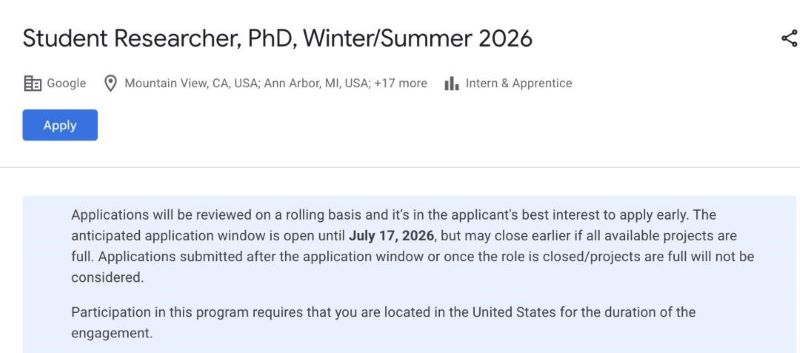
Google Student Researcher Program
Google’s rolling-recruitment Student Researcher program targets PhD students in computer science and related fields within the United States. Participants gain the opportunity to join teams such as Google DeepMind and Google Research, engaging in project-based research initiatives.
Described on Google’s official website as “exploratory projects advancing scientific progress across multiple research areas,” the program covers a broad range of cutting-edge directions including large models, search and recommendation systems, reinforcement learning, and graph learning, as well as foundational technical areas such as systems, algorithms, and privacy and security.
Work arrangements offer flexibility, with positions structured as full-time summer roles or part-time projects during the academic semester, depending on team requirements. Work locations include various Google offices across the United States. The base annual salary ranges from $113,000 to $150,000, supplemented by standard benefits including partial medical coverage, meals, and transportation allowances. Applications are reviewed on a rolling basis, with the window expected to remain open until approximately July 17, 2026. Early application is encouraged for optimal consideration, and applications can be submitted through Google’s careers platform.
Meta Research Scientist Intern & Visiting PhD
Meta is offering multiple research internship positions spanning 12 to 24 weeks, targeting PhD candidates or individuals with equivalent research backgrounds. Monthly compensation ranges from $7,650 to $12,000.
Key research focus areas include Neural Rendering, Natural Language Processing, Generative Modeling (covering multi-modal generative models for images, videos, and text), and Computer Vision. Applications are available through Meta’s career website.
In addition to short-term internships, Meta offers a Visiting PhD program for technical doctoral students from select universities, including the University of Washington, Carnegie Mellon University, University of California, Berkeley, and New York University. The one-year program allows students to work part-time during the academic year, balancing their doctoral research with Meta’s project requirements.
Applications for the 2026–2027 Visiting PhD program opened on November 17, with a deadline of January 9 of the following year. The program officially commences in the fall of 2026, requiring participants to reach an agreement with their home universities to coordinate academic progress and work commitments at Meta.
As the AI industry evolves, academic credentials are increasingly supplemented by practical capabilities and innovative ideas as core competencies. These high-value internship and residency programs not only reflect the intense competition for AI talent but also serve as platforms for nurturing the next generation of AI professionals. By integrating participants into frontline research and engineering projects, these initiatives accelerate skill development while addressing the industry’s growing demand for qualified talent.



Related Articles
Lorem ipsum dolor sit amet
Lorem ipsum dolor sit amet consectetur adipiscing elit. Quisque faucibus ex sapien...
Lorem ipsum dolor sit amet
Lorem ipsum dolor sit amet consectetur adipiscing elit. Quisque faucibus ex sapien...
Découvrez le monde passionnant de Nine Casinos : votre guide complet
Le secteur des casinos en ligne ne cesse de croître, offrant aux...
Découvrez comment la technologie révolutionne l’expérience des casinos en ligne
Avec plus de 60 % des joueurs français qui préfèrent désormais jouer...