

Frank Gehry: A Legend Who Reshaped Architectural Language and His Enduring Legacy
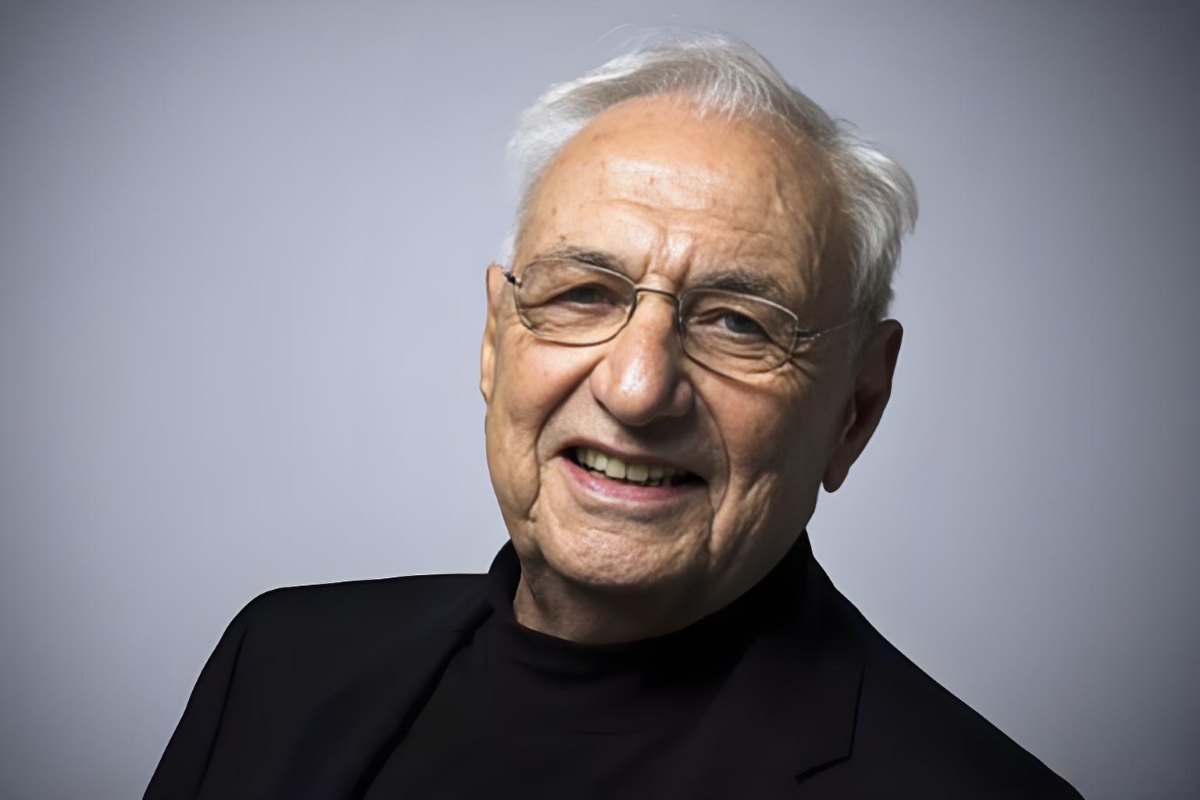
The renowned architect Frank Gehry, who passed away at the age of 96, profoundly shaped the discourse of the global architectural community over his more than seventy-year career. Centered on material experimentation, iterative model-making, and the exploration of fluid, expressive forms, he developed a unique design language. His works span diverse fields including residences, cultural institutions, and public landscapes, witnessing the transformation of manufacturing technologies, the evolution of museum typologies, and adjustments in urban renewal strategies. Furthermore, he pioneered innovative digital solutions to architectural complexity, leaving behind a profound and enduring architectural legacy.
Early Explorations: An Experimental Departure from Tradition
Gehry’s own residence, completed in 1978, marked a pivotal starting point in his career. Instead of demolishing the existing Dutch Colonial-style house, he surrounded it with new volumes, exposing the structural framework and incorporating angular geometric shapes that starkly contrasted with the original building. Unconventional materials such as plywood, corrugated metal sheets, glass, and chain-link fencing combined to create an intentionally unfinished aesthetic, challenging traditional residential norms and sparking local controversy. A subsequent expansion in 1991 met the family’s needs while preserving the project’s experimental nature, further solidifying its significance in California’s architectural landscape.
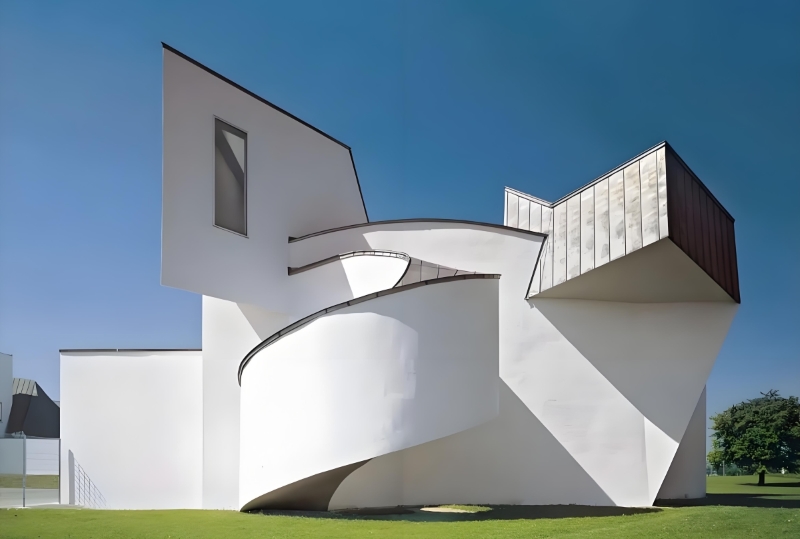
Completed in 1989, the Vitra Design Museum—Gehry’s first building in Europe—signaled a crucial shift toward the sculptural forms that would define his later works. Located within the Vitra Campus in Weil am Rhein, the building emerged during the company’s post-fire reconstruction, transforming a simple warehouse requirement into an independent institution dedicated to design. Composed of interlocking curved and angular volumes, its white plaster surfaces and zinc roof exude dynamic beauty, representing Gehry’s transition from the sharp, deconstructivist language of his early projects to more fluid geometric forms.
Mature Style: Cultural Landmarks as Catalysts for Urban Transformation
In 1996, the Dancing House in Prague—co-designed by Gehry and Vlado Milunić—introduced Gehry’s emerging formal language to a prominent riverside site. The design integrates a gracefully curved glass tower with a more rectilinear masonry volume, establishing a vivid dialogue between dynamic and static forms. Constructed using custom-molded concrete panels and meticulously designed facade elements, the project reflects Gehry’s keen interest in sculptural composition and the interaction of geometric shapes. Its spatial and material strategies demonstrate his ability to integrate expressive forms into urban public contexts, marking a key milestone in his progression toward large-scale cultural projects in the late 1990s.

The Guggenheim Museum Bilbao, which opened in 1997, stands as his magnum opus. Nestled along the Nervión River, the building combines intricate, winding forms with layered material combinations, thoughtfully responding to its industrial setting and multifunctional needs. Launched in 1991 as part of Bilbao’s ambitious plan to revitalize its old port area, the museum quickly became a major cultural landmark, attracting millions of visitors. Its titanium, limestone, and glass surfaces—shaped into curves using CATIA software—allowed Gehry to translate handcrafted models into constructible geometries. A light-filled atrium organizes 19 galleries, manifested on the facade through a mix of regular and organic volumes. The building’s architectural impact and economic benefits defined the widely recognized “Bilbao Effect,” highlighting its enduring influence on the relationship between cultural institutions and urban transformation.
Diversified Expansion: Sustained Innovation Across Types and Regions
In the 2000s, Gehry’s works became increasingly diverse. The Walt Disney Concert Hall, completed in 2003 as the new home of the Los Angeles Philharmonic, merges a sculptural stainless steel facade with an acoustic space developed through close collaboration between Gehry and acoustician Yasuhisa Toyota. The Jay Pritzker Pavilion in Chicago, finished in 2004, is an open-air performance venue within Millennium Park designed by Gehry Partners, hosting the Grant Park Symphony Orchestra and various musical events, and large glass doors enable year-round community events. In 2014, the Fondation Louis Vuitton in Paris honors the garden’s historic glass pavilion tradition while creating a distinctive contemporary museum atmosphere. Composed of a series of white “iceberg”-like volumes clad in fiber-reinforced concrete. Also completed in 2014, the Biomuseo in Panama City integrates museum architecture, exhibition design, and surrounding parkland into a comprehensive educational environment. The Dr. Chau Chak Wing Building in Sydney, completed in 2015 as part of the University of Technology Sydney’s urban campus masterplan, marks Gehry’s first project in Australia, introducing a unique design concept to business school architecture. Completed in 2021, the LUMA Arles Tower in France serves as the centerpiece of the 27-acre Parc des Ateliers redevelopment. Once an industrial site, the park has been transformed into a creative hub for artists and researchers.
Gehry’s design evolved in tandem with technological advancements, adopting aerospace engineering software to overcome the challenges of constructing unconventional geometries and influencing broader industry standards. Though the master has passed away, his design methodology, dedication to innovation, and profound understanding of cultural architecture continue to shape the latest trends of global architecture. The Guggenheim Abu Dhabi, scheduled to open in 2026 in the Saadiyat Cultural District, will carry forward his iconic design themes, serving as a continuation of Gehry’s architectural exploration and a testament to his role in advancing cultural institutions worldwide.


Related Articles

Local Moves for Clean Energy’s Spatial Impacts
January 26 marks the International Day of Clean Energy, an initiative raising...

Architecture’s Blue Notes: Tension and Subtle Deviations
The pentatonic scale, a musical framework built from just five notes, creates...

Niall McLaughlin to Win 2026 RIBA Royal Gold Medal
The Royal Institute of British Architects has named Irish architect, educator and...


Composites Reshape Modern Architecture Globally
Once confined to aerospace and automotive industries, composite materials have emerged as...