

Humanoid Robot Atom Debuts in Shenzhen Cinemas
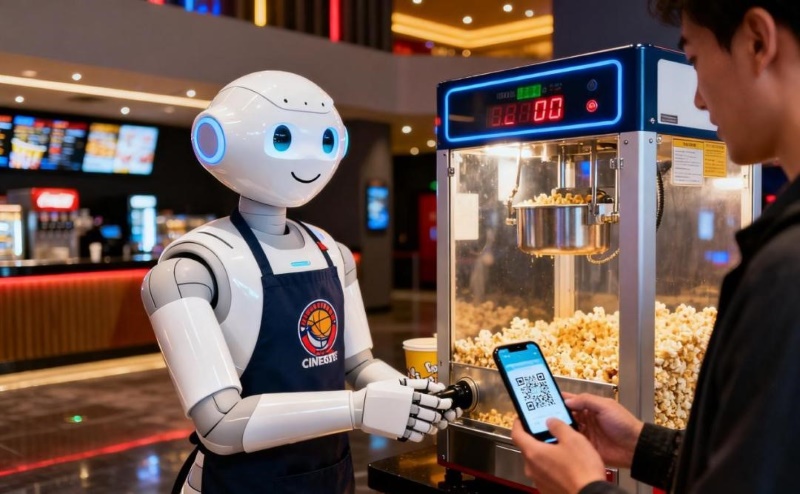
In early 2026, Shenzhen’s cinema scene witnessed a technological milestone as Atom, the world’s first fully autonomous humanoid robot, officially entered service. Developed by Chinese tech firm Yuejiang Technology, the robot has achieved a breakthrough in complex commercial scenario application—independently handling the entire popcorn service chain without human assistance.
Debut Performance & Core Capabilities
During its maiden deployment, Atom operated continuously for 14 hours with zero errors, completing over 1,000 popcorn orders including order recognition, cup grabbing, precise filling, and product handover. What sets it apart is its ability to autonomously respond to unexpected situations: when faced with popcorn spills, container displacement, or human interference, the robot can quickly identify task deviations, conduct self-diagnosis, and trigger dynamic replanning to resume operations without external commands.
Beyond popcorn service, Atom’s functional scope extends to multiple daily and commercial tasks. It is capable of preparing breakfast (including toasting bread, cooking bacon, arranging fruits, and pouring milk), receiving corporate clients, serving coffee, delivering documents, and collecting parcels. Priced starting at 199,000 RMB (approximately $27,500), the robot offers significant cost advantages for businesses compared to human labor.
Technically, Atom is positioned as the world’s first embodied intelligent humanoid robot with “dexterous operation + straight-knee walking” capabilities. Equipped with a neuro-driven dexterous operating system inspired by human brain-hand coordination mechanisms, it adopts a Transformer-based model architecture and human-like binocular RGB vision drive, enabling end-to-end autonomous reasoning and operation with up to 28 upper-limb degrees of freedom.
Market Expansion Strategy
Yuejiang Technology initially outlined a strategic plan in 2025 to “expand to 10 core cities after cinema verification.” Adjustments were later made to align with scenario adaptation, supply chain progress, and partnership implementation rhythms: the company aims to complete pilots in 3-5 core cities by 2025 and scale to 10 cities nationwide in 2026.
For enterprises, the adoption of such digital employees brings multiple benefits. Beyond reducing labor costs (eliminating needs for salaries, benefits, and rest periods), Atom maintains consistent efficiency and service quality, operating tirelessly with a friendly and patient demeanor. Its high programmability and flexibility also allow businesses to easily adjust workflows and task allocations, optimizing resource configuration.
Industry-Wide Automation Trends
Atom’s deployment reflects a broader shift in the service and manufacturing industries, as more robotics firms accelerate the commercialization of humanoid and embodied intelligent technologies:
- At Foton Cummins Engine’s factory in Beijing, robots including “Embodied Tiangong 2.0” and “Tianyi 2.0” have completed the “last mile” verification from laboratory to real production. They autonomously handle bin picking, transportation, and adapt to different storage heights and bin types on unmanned production lines.
- Zhipingfang, an embodied intelligence unicorn, has launched a robot-operated coffee shop at Beijing’s Chaoyang Park—joining Yinhe General, Xingchen Intelligence, and other startups in bringing robotic services to commercial districts and scenic areas.
- Yushu Technology opened the world’s first offline experience store at JD MALL Shuangjing Branch in Beijing. Consumers can interact with robots in home, education, entertainment, and elderly care scenarios, with real-time feedback supporting product iteration and accelerating consumer adoption.
These developments highlight the rapid penetration of digital employees across industries. From precision robotic arms on production lines to intelligent voice assistants in customer service centers, and automated sorting systems in logistics warehouses, robots are increasingly taking over tasks traditionally performed by humans.
Technical Evolution & Market Impact
The commercialization of robots like Atom marks a key transition in humanoid robotics—from demonstration-only capabilities (such as walking and dancing) to practical, task-completing applications. This shift is reshaping the labor market landscape, particularly in roles characterized by high repetition and labor intensity.
Industry observers note that the ongoing advancement of AI and robotics technology is driving widespread automation in sectors including catering, retail, manufacturing, and logistics. As robots demonstrate advantages in efficiency, cost-effectiveness, and consistency, their adoption is expected to accelerate, bringing profound changes to traditional employment structures.
With continuous technological iteration and expanding application scenarios, humanoid robots and embodied intelligent systems are poised to become a core driver of industrial transformation. As more enterprises integrate digital employees into their operations, the global service and manufacturing industries are entering a new era of human-machine collaboration.


Related Articles

Humanoid Intelligence Faces a Long Road to Practical Adoption
The stage of China’s 2026 Spring Festival Gala became a grand showcase...

Chinese Robots Make Debut at Paris Chinese New Year Parade on Champs-Élysées
In early February, the Champs-Élysées in Paris hosted its annual Chinese New...
Dexterous Hands: The Unsurpassable Hurdle in Humanoid Robot Development
In the development of humanoid robots, the dexterous hand can be called...


New Approach to Robot Hand-Eye Coordination
In recent years, artificial intelligence (AI) has become the focal point of...