

ChatGPT’s 3rd Anniversary Meets Google Gemini’s Challenge
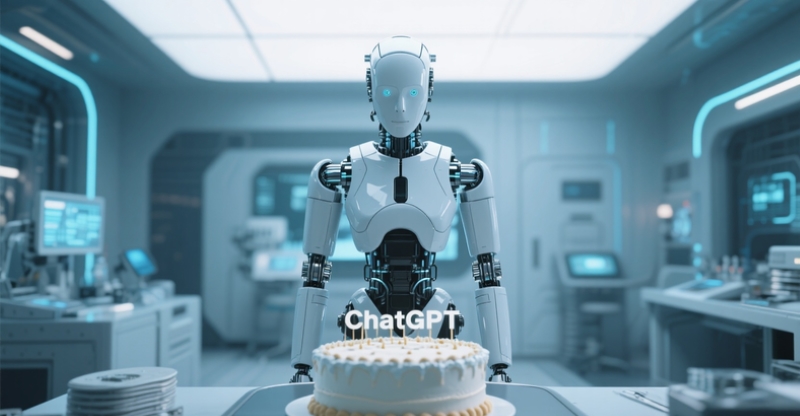
On December 1, 2025, as ChatGPT celebrated its third anniversary, Google launched a powerful assault with the release of Gemini 3. Once the undisputed leader in AI, OpenAI now faces a formidable challenge, marking a critical turning point in the global AI industry landscape.
Three years earlier, on December 1, 2022, OpenAI quietly unveiled the research preview of ChatGPT. With nothing more than a simple dialogue box, it attracted 1 million users in just five days and eventually became the fastest-growing application in history to reach 1 billion users. Over these three years, AI technology has evolved along a clear trajectory: 2023-2024 was the honeymoon period of human-machine dialogue, where Prompt Engineering emerged as a popular skill. People marveled at AI’s human-like interaction capabilities, even as the technology struggled with “hallucinations.” 2024-2025 then ushered in the era of multimodal explosion—products like GPT-4o and Midjourney endowed AI with the ability to process images, audio, and video. Vibe coding gained traction, reshaping production relations, while releases such as Sora 2 and Google’s Nano Banana continued to fuel excitement around the latest AI trend.

OpenAI’s GPT series has long led the technological frontier, with GPT-5 achieving breakthroughs in core metrics like speed, reasoning ability, and accuracy. However, Google has risen through sustained efforts with its native multimodal model Gemini, built on TPU infrastructure. The monthly active users (MAU) of the Gemini mobile app surged from 400 million in May to 650 million, and users now spend more time per session on Gemini than on ChatGPT. Many industry leaders, after testing the platform, openly admitted they “can’t go back.”
Shifting Dynamics: OpenAI’s Triumphs and Hidden Risks
Behind the AI boom, NVIDIA has emerged as the biggest winner—its stock price has soared nearly 10-fold over three years, reaching a market value of $5 trillion. Meanwhile, OpenAI basks in technological dividends while grappling with mounting pressures: to maintain its lead, the company has expanded its reach across multiple fronts, from programming tools to video applications, and plans to invest $1.4 trillion in computing power over eight years.
OpenAI’s unique “asset-light” model shields it from financial risks—partners like SoftBank and Oracle have taken on nearly $100 billion in debt on its behalf, while the company’s own $4 billion credit line remains unused. However, experts warn that overexpansion may spread resources too thin. Facing fierce competition from giants like Google, internal pressure at OpenAI has intensified. OpenAI CEO Sam Altman preemptively warned employees that “the external atmosphere will be tough for a while.”
What should have been a milestone third anniversary has instead become a watershed for the AI industry. Three years ago, OpenAI’s surprise launch reshaped the sector; now, Google has announced its return with a similar surprise attack. This high-stakes gamble on technological routes and commercial prospects continues. Whether OpenAI can hold its ground amid the giants’ encirclement, and whether Google can expand its advantage, will determine the future direction of the AI industry. Beyond driving rapid technological iteration, this competition is forcing human society to rethink and adapt to the AI era.



Related Articles
Lorem ipsum dolor sit amet
Lorem ipsum dolor sit amet consectetur adipiscing elit. Quisque faucibus ex sapien...
Lorem ipsum dolor sit amet
Lorem ipsum dolor sit amet consectetur adipiscing elit. Quisque faucibus ex sapien...
Découvrez le monde passionnant de Nine Casinos : votre guide complet
Le secteur des casinos en ligne ne cesse de croître, offrant aux...
Découvrez comment la technologie révolutionne l’expérience des casinos en ligne
Avec plus de 60 % des joueurs français qui préfèrent désormais jouer...