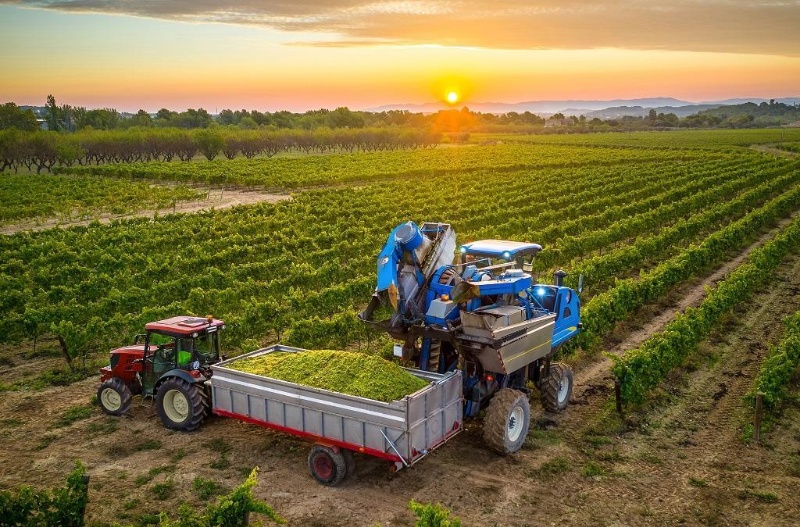
Today, GPS-guided tractors and digital agricultural management systems have become commonplace on modern farms. With the continuous advancement of artificial intelligence, “autonomous farms”—which can complete planting and harvesting with almost no manual intervention—are gradually moving from concept to reality. The Washington Post recently highlighted a series of key technologies that are laying the groundwork for these autonomous farms. Some of these technologies have already entered trial use, while others are soon to hit the market, collectively reshaping agricultural production models across cultivation, harvesting, and monitoring—a clear reflection of the agricultural new trend development.
Ground Operations Automation: Smarter Cultivation, Harvesting, and Spraying
In the field of ground-based agricultural operations, autonomous equipment that requires minimal human intervention has emerged as a core area of breakthrough, attracting investment from both traditional agricultural machinery giants and tech startups. The all-electric MK-V tractor launched by U.S.-based Monarch Tractor supports a “driverless” mode and is currently in use in vineyards. With a 6-hour charge, it can operate continuously for 14 hours, significantly reducing reliance on manual labor.
Farmwise, an agritech startup, has combined AI with computer vision to develop weeding equipment capable of working around the clock. This device can accurately identify and remove weeds, drastically cutting down on herbicide usage. In April this year, Taylor Farms—a major agricultural enterprise—acquired the company, aiming to leverage this technology to further lower labor costs and drive the transition toward more sustainable farming practices.
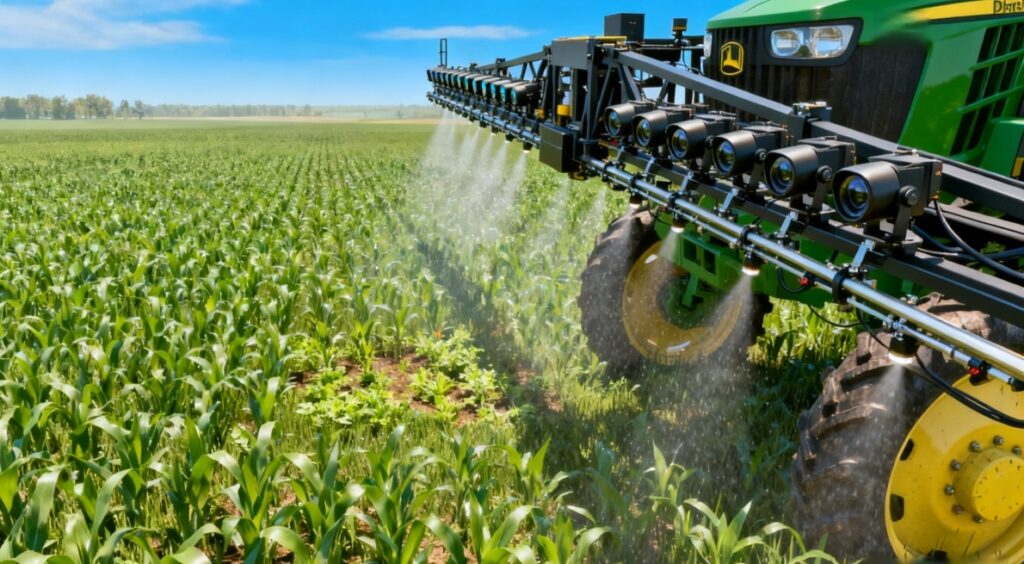
Deere & Company, a global leader in agricultural machinery, has adopted a “phased advancement” strategy to gradually add automated features to its equipment. Its developed “Identify and Spray” system, which integrates computer vision and machine learning, is already being used in the cultivation of corn, soybeans, and cotton. Equipped with 36 cameras on its sprayer booms, the system can scan nearly 200 square meters of farmland per second—far exceeding human processing limits. It can identify weeds while precisely controlling nozzles to spray only the weed-infested areas, reducing herbicide use by up to two-thirds. “In the future, we may be able to use AI to create customized care plans for each individual plant,” said Sarah Schenker, Director of Emerging Technologies at Deere & Company. She emphasized that achieving “plant-by-plant management” for 750 million crops across 20 square kilometers of farmland would be impossible without the deep integration of AI and automation.
Specialty Crop Harvesting: Robots Address Labor Dependence Challenges
Compared to staple crops that grow in neat rows, “specialty crops” such as strawberries and grapes have long relied on large amounts of manual labor for harvesting due to their uneven ripening and fragile fruits—making automation far more challenging. However, this industry pain point is gradually being resolved by new technologies.
Tortuga, a Denver-based agritech startup, has developed a fruit-picking robot that resembles a “Mars rover.” Equipped with thick tires and a telescopic robotic arm, it can move flexibly through fruit fields. The arm can reach into vine clusters to accurately pick individual strawberries or entire bunches of grapes, gently placing them into storage baskets. In March this year, Oishii—a vertical farming company—acquired Tortuga. Brendan Somerville, Co-Founder of Oishii, stated that the robots not only improve harvesting efficiency and ensure more consistent quality but also effectively alleviate agricultural labor shortages. The company’s goal is to achieve fully automated harvesting of specialty crops.
Israel’s Tevel Aerobotics has taken a different approach by developing “flying fruit-picking robots.” Combining AI and machine vision, these robots can accurately locate fruits, assess their ripeness, and complete harvesting. However, the company acknowledges that due to cost constraints, this technology has not yet been deployed on a large scale and requires further optimization to lower application barriers.
Digitalization Empowers Agricultural Decision-Making
AI’s transformation of agriculture extends beyond ground operations to encompass comprehensive monitoring and management. High-resolution images and sensor data collected by drones and satellites help farmers build “digital twin” models of their farmland. These models provide real-time updates on field conditions such as droughts, waterlogging, and pest infestations, enabling early detection and intervention to reduce resource waste and boost crop yields.
Currently, some components of these monitoring systems are already in use. The next stage of development will focus on building interconnected automated networks—systems that not only detect problems in a timely manner but also continuously optimize solutions through machine learning. Ranveer Chandra, Head of Microsoft’s Agricultural Technology Program, envisions a future where tractors and drones work in synergy: while completing planting and spraying tasks, they will transmit data in real time to continuously refine AI models tailored to individual farms. “The future of agriculture will not be farmerless,” Chandra emphasized. “Instead, AI will greatly enhance farmers’ productivity. Every flight and every sowing operation will add data to the farm’s AI model, making decision-making more precise.”
In addition, soil management has undergone intelligent upgrades. In the past, farmers had to send topsoil samples to laboratories for analysis; now, sensors can work directly in the field. These sensors not only monitor soil microbial activity but also identify “soil compaction” areas—regions where overly dense soil hinders water infiltration, root growth, and gas exchange. Canada’s SoilOptix notes that microbial analysis allows farmers to more accurately track changes in field conditions. Instead of applying pesticides or irrigation uniformly across entire fields, farmers can now use sensor data to select precise operation areas, adjust chemical dosages, and optimize timing—achieving more efficient resource utilization.
In the livestock industry, virtual fencing technology is gradually replacing traditional barbed wire and wooden stakes. Based on GPS collars and electronic maps to set boundaries, the technology issues an audio warning when livestock approach the boundary; if the animals continue to move closer, the collars deliver a mild electric shock as a reminder. This system not only reduces the cost of fence construction and maintenance but also allows for dynamic adjustments to grazing areas based on pasture needs. Currently, it is being gradually promoted in the United States, Europe, and Australia, and is particularly suitable for large-scale grazing management in remote areas—opening up new possibilities for the digital transformation of agriculture.