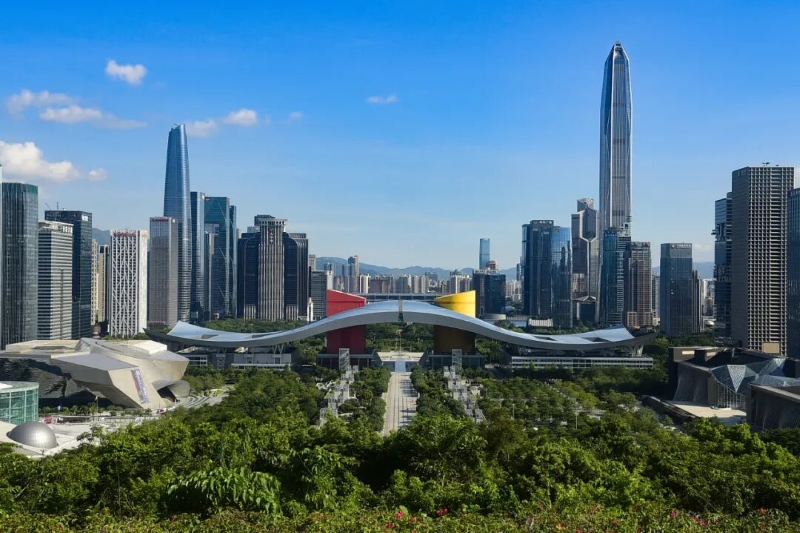
As a window to China’s reform and opening-up and a “City of Design”, Shenzhen has transformed from a border town into an international metropolis in over 40 years, with its architectural development deeply embodying the city’s spirit. Over the past decade (2015-2025), Shenzhen’s architecture has broken out of the framework of merely pursuing “Shenzhen Speed”. Integrating the city’s open and inclusive character, the ecological advantage of being surrounded by mountains and seas, and the local spirit of blending tradition with innovative technology, it has achieved a qualitative leap in five dimensions: high-rise buildings, urban renewal, educational architecture, public cultural buildings, and ecological infrastructure, completing a magnificent transformation from scale expansion to precision improvement.
Multidimensional Breakthrough: Dual Upgrade of Architectural Form and Function
In the field of high-rise buildings, Shenzhen has become the city with the highest building density and the most super-high-rises over 200 meters in China. Areas such as Shenzhen Bay Super Headquarters Base and Qianhai have gathered practices from top global design teams, giving shape to the iconic tallest buildings in Shenzhen including DJI Sky City, China Resources Tower, and Ping An Finance Center. These structures not only refresh the city’s skyline but also highlight the improvement of architectural quality with their unique forms, making high-density building clusters a distinctive symbol of the city’s image.

Urban renewal showcases the “dual coexistence” wisdom of Shenzhen’s architecture. Faced with the coexistence of glass skyscrapers and urban villages, Shenzhen has promoted the activation and upgrading of areas such as Nantou Ancient Village, centered on “integration of industry and city” and “community symbiosis”. Projects like the renovation of Kingway Brewery and Nantou Ancient City Creative Factory have realized the sustainable renewal of existing urban spaces such as vacant buildings and former industrial sites by introducing creative industries and activating artistic design, preserving the humanistic scale and diverse characteristics of urban villages while integrating them into the context of modern urban development.
The innovation in educational architecture and public cultural buildings is equally striking. Against the backdrop of scarce land resources, Shenzhen’s educational architecture has broken through traditional layouts to create diverse forms such as “vertical campuses” and “three-dimensional ecological campuses”. The “Hundred Schools Renovation” program has upgraded the quality of 38 old schools, and differentiated solutions covering all school stages have met the needs of educational development. Meanwhile, the concentrated construction of the “Top Ten Cultural Facilities of the New Era” has attracted participation from Pritzker Architecture Prize winners such as Jean Nouvel. Buildings like the Sea World Culture and Arts Center and Shenzhen Science and Technology Museum, adhering to the latest architecture trend of open and shared design and multi-functional integration, have addressed the city’s cultural shortcomings and achieved seamless connection between cultural spaces and daily life.
Ecological Symbiosis: Harmonious Reconstruction of Infrastructure and Nature
Faced with challenges such as scarce land and ecological pressure, Shenzhen’s architects have adhered to the principle of “respecting nature and minimal intervention” to create infrastructure buildings integrated into the landscape. Projects including Pingshan Balcony, Longgang River Greenway Pavilion, and the circular treehouse in Dashahe Ecological Corridor have reconstructed the connection between “infrastructure – humans – nature”, allowing citizens to experience the integration of nature in daily use. While protecting the ecological base, these projects have resolved the contradiction between urban development and environmental carrying capacity.
From the skyline of super-high-rises to the warmth of urban villages, from the three-dimensional growth of campuses to the open sharing of cultural spaces, and to the innovative practices of ecological infrastructure, the multidimensional development of Shenzhen’s architecture is not only a renovation of the city’s appearance but also a vivid interpretation of the “City of Design” spirit, providing a vivid model for the architectural upgrading and sustainable development of mega-cities.