
Tesla’s 4680 battery project, which the company has vigorously advanced for over five years, has ultimately come to a standstill due to multiple challenges. According to an announcement from key supplier L&F, the value of its high-nickel cathode material supply contract with Tesla has plummeted from $2.9 billion to a mere $7,386, representing a impairment of over 99%. This effectively signals the de facto collapse of the Tesla 4680 battery project that relied on this customized material.
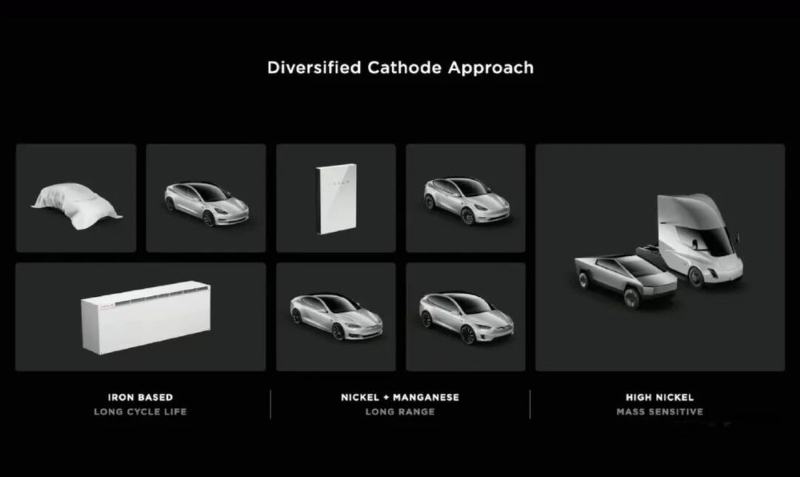
Per Tesla’s plan, the Model 3 is primarily powered by lithium iron phosphate batteries, the Model Y/S/X adopt nickel-manganese-containing ternary lithium batteries, while the Cybertruck and Semi utilize high-nickel cathode ternary lithium batteries. Unveiled at Tesla’s “Battery Day” in 2020, the 4680 battery—tailor-made for the Cybertruck and Semi—boasted ambitious goals: a fivefold increase in cell energy density, a 16% boost in driving range, a sixfold improvement in power output, and a 56% reduction in cost per kilowatt-hour. Measuring 46 millimeters in diameter and 80 millimeters in height, this cylindrical battery, compared to the previous 2170 battery, reduces the number of cells required in each battery pack through its larger size to cut costs. Meanwhile, it was designed to achieve its targets through five core technical pathways: “full-tab (tabless, as termed by Tesla) design, high-nickel cathode, silicon-doped anode, dry electrode, and battery-body integration,” and was regarded as the cornerstone of Tesla’s “low-cost battery – affordable vehicle” initiative.
However, this leapfrog technical route has been fraught with obstacles. While the full-tab design resolved the issue of long electron transmission paths in traditional tabs, upgrades to cathode and anode materials as well as innovations in production processes have repeatedly hit snags. The first-generation 4680 battery, adopting the NCM811 (nickel-cobalt-manganese in an 8:1:1 ratio) formulation, failed to meet expectations in terms of energy density and charge-discharge performance. The second-generation model, which switched to L&F’s 95% high-nickel cathode, saw improved energy density, but the silicon content in its silicon-doped anode remains far below the 20% design target. Additionally, the expansion rate challenges and high costs associated with high silicon content remain unsolved. As a key cost-cutting technology, the dry electrode process poses immense mass production difficulties, with complex control requirements for uniform raw material mixing and coating. Even Chinese and South Korean battery manufacturers have scheduled the commercialization of dry electrode technology for 2027-2028, and after Tesla launched a prototype Cybertruck equipped with dual dry electrodes in 2024, there has been no further progress on mass production, as highlighted in latest industry news.
The market failure proved to be the final straw that broke the camel’s back. When the Cybertruck—equipped with the 4680 battery—was unveiled in 2019, it promised a price range of $39,900 to $69,900 and a maximum EPA range of 805 kilometers. However, upon its official launch at the end of 2023, it faced a double blow: a sharp price hike and a significant reduction in driving range. The high-end version’s price soared to $114,900, while its range dropped to just 515 kilometers. By the end of 2023, the total delivery volume of the Cybertruck stood at approximately 50,000 units, a far cry from Musk’s target of 250,000 annual sales. It even had to rely on internal procurement by SpaceX to clear inventory.
Today, Tesla’s automotive business is mired in difficulties, with global sales declining by 8.6% in 2025 and growth stagnating for three consecutive years. Meanwhile, Musk’s focus has shifted to new ventures such as xAI, robotics, and brain-computer interfaces, leaving the 4680 battery project gradually becoming a “tasteless burden.” This five-year technical campaign, though it provided the industry with forward-looking technical insights, ultimately failed due to Tesla’s overly aggressive leapfrog strategy, which could not balance technological breakthroughs with market implementation.