

Former Google CEO Schmidt Couple to Privately Fund Large Space Telescope

Recently, former Google CEO Eric Schmidt and his wife Wendy announced a major scientific initiative: they will privately fund the development of a space telescope named the “Lazuli Observatory.” This project represents a significant engineering milestone in the field of space technology and is expected to have a profound impact on the history of space telescope development.
According to Science magazine, the Lazuli Observatory was first unveiled at a meeting of the American Astronomical Society. With a primary mirror diameter of 3.1 meters, the telescope demonstrates remarkable optical engineering, designed to be equipped with a wide-field camera, a broadband integral field spectrograph, and a coronagraph, primarily focusing on the study of various cosmic phenomena such as exoplanets and supernovae.
Notably, the Lazuli Observatory possesses a “rapid response” capability, a feat of precision engineering that allows it to quickly adjust its orientation and acquire data after other telescopes have identified targets, thereby enhancing the efficiency of observing transient cosmic events.
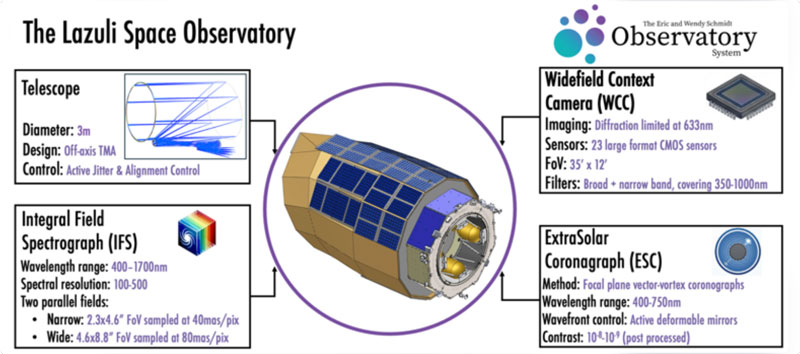
The Lazuli Observatory is part of the Schmidt Observatory System, which also includes multiple ground-based observation facilities such as the Argus Array, the Deep Synoptic Array, and the Large Fiber Array Spectroscopic Telescope. According to the latest news, the Schmidt Scientific Research Institute stated that these projects will adhere to the principles of open science, with observational data and software being shared with the global scientific community to promote international cooperation and research progress.
This investment by the Schmidt couple once again highlights the potential of private capital in advancing cutting-edge scientific exploration. It is reported that four related projects, including the Lazuli Observatory, are expected to become operational by the late 2020s, potentially bringing new breakthroughs to humanity’s understanding of the universe.
As private involvement in space exploration continues to grow, projects like the Lazuli Observatory may open up new possibilities for astronomical observation, further expanding the boundaries of human exploration of the cosmos.


Related Articles

SpaceX’s Strategic Pivot: Prioritizing the Moon over Mars
In February 2026, SpaceX officially announced that it would put its Mars...

Space Mining: The Interstellar Resource Race Moving from Science Fiction to Reality
In 2026, the prelude to the first year of space industrialization is...

Nighttime Solar Technology Emerges, with Space Applications as the Core Direction
The “nighttime solar” technology developed by the Photovoltaic and Renewable Energy Engineering...


IABSE 2025 Engineering Awards Announced
On November 14, the International Association for Bridge and Structural Engineering (IABSE)...