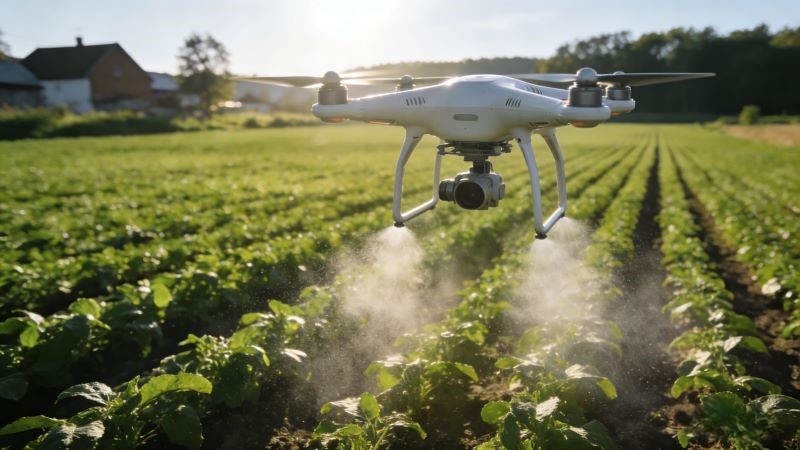
Different regions have developed distinct agricultural drone development paths based on their resource endowments and agricultural needs. Drone application scenarios are deeply adapted to local agricultural production models, driving regional industrial implementation and iteration. Here’s an overview of the global agri-drone landscape:
China: Leader in Tech Export & Ecosystem
China maintains its position as the world’s top agri-drone market with a 40% global share. In 2024, its drone farming operation area exceeded 1.73 billion hectares, and the market size reached approximately $18.2 billion, characterized by “technology leadership + policy support + sound ecosystem.”
DJI, a key player, exports products to over 100 countries and regions, offering solutions covering staple grains, cash crops, and various terrains. Nationally, “low-altitude economy” has been elevated to a national strategy, with the “Interim Regulations on the Administration of Unmanned Aircraft Flight” clarifying operational standards. The Ministry of Agriculture and Rural Affairs has conducted 26 pesticide application trials for staple crops, supported by 81 standards spanning equipment manufacturing, operator training, and safety management. A complete industrial chain has formed, encompassing core component production (batteries, sensors), whole-machine manufacturing, special formulation R&D, pilot training, and operational services.
Brazil: Scaled Agriculture & Regulatory Ease
As one of the world’s most dynamic agrochemical markets, Brazil’s agri-drone fleet has surged from 3,000 in 2021 to 35,000 in 2025, focusing on “large farm adaptation + regulatory optimization + local innovation.”
Targeting contiguous crops like soybeans, corn, and cotton, Brazil has built an “air-ground” three-dimensional application system integrating drones, agricultural aircraft, and intelligent boom sprayers. Half of its 2,700 agricultural aircraft use ethanol fuel, collaborating with drones to achieve 1,500-2,000 hectares of daily operations, meeting the needs of large-scale farms in tropical grasslands.
Regulatory reforms have boosted growth: the 2021 Decree No. 298 standardized drone operations, and the 2024 revised “Biological Inputs Law” simplified approval for biological and drone-specific formulations. The civil aviation authority lifted mandatory airworthiness certification for agri-drones, requiring only 40 hours of training for operators, lowering market entry barriers. Chinese brands like DJI hold 60% of the market, while local firms GTEEX and SkyDrones thrive through differentiation—SkyDrones’ KING-150 MAX, with high load capacity and local parts supply, is favored for intensive large-farm operations.
India: Policy-Driven & Smallholder-Centric
India has identified agri-drones as a core driver of agricultural modernization, launching multiple national promotion programs in 2025 to adapt to smallholder needs and accelerate technology adoption.
Policy support includes 50% subsidies (up to 500,000 rupees) for drone purchases via initiatives like the “Kisan e-Mitra” AI chatbot and “NAMO DRONE DIDI,” which also supports women’s self-help groups (SHGs) in providing plant protection services. By the end of 2025, 2,100 drones have been approved for farmer use and Custom Hiring Centers (CHCs), reducing access barriers for smallholders.
Local enterprises tailor products to fragmented farmlands: AvironiX’s backpack-sized AviSpray-10c is 53% smaller than traditional models, transportable by two-wheelers and operable by one person, covering 0.33 hectares per charge. Jyoti Global Plast’s AeroCrop, with 22-minute battery life and 2-hectare daily efficiency, is a top choice for small and medium farmers. Drones are widely used in precision pesticide application for rice, cotton, and sugarcane, as well as monsoon sowing decisions and pest monitoring. The ICAR and Krishi Vigyan Kendras have conducted demonstrations across 41,000 hectares, benefiting 450,000 farmers and popularizing scientific drone farming.

US: Precision & Sustainable Agriculture
The US agri-drone market features “precision + sustainability + commercialization,” focusing on high-value crops and sustainable agriculture to build a premium service system.
Companies like EagleNXT (formerly AgEagle) and EVTV offer drones equipped with multispectral sensors for precision tasks such as corn nitrogen management and grape disease monitoring. The University of Missouri’s AI algorithm analyzes drone imagery to estimate corn chlorophyll levels, guiding variable-rate fertilization and reducing nitrogen use by 30%, balancing efficacy and ecology.
Commercial service models are mature, with companies charging by the hectare. EVTV partners with Italy’s Studio Baffetti to provide drone spraying for Tuscany vineyards, cutting chemical use by 40% and reducing soil erosion. The FAA has simplified Beyond Visual Line of Sight (BVLOS) operation approvals, adding models like DJI to the exemption list while enforcing environmental compliance, promoting integration with biological formulations and organic farming techniques.
Emerging Markets: Leapfrog Growth
Africa and Southeast Asia are achieving agricultural modernization through leapfrog development of agri-drones, focusing on food security and pest control, with the fastest market growth globally in 2025.
In Africa, Kenya, Senegal, and Ghana have launched national drone programs. Senegal’s Agricultural Protection Agency introduced six next-generation drones, covering 25 hectares per hour to enhance fall armyworm control. Ghana’s KaraAgroAI combines drones with AI to provide disease diagnosis and precision spraying for cashew farmers, covering 100,000 hectares and boosting crop yields.
In Southeast Asia, Indonesia and Vietnam are growth hubs. Terra Drone and XAG cooperate with local governments to promote drone use in oil palm and rice cultivation. Terra Drone Indonesia’s G20 drone, certified with local content (TKDN), partners with Yanmar Diesel Indonesia to deliver 120 units annually for rice pest control. XAG’s drones have reduced pesticide use by 30% and improved efficiency fivefold at Indonesia’s Sang Hyang Seri Farm, adapting to dense tropical crop planting.