

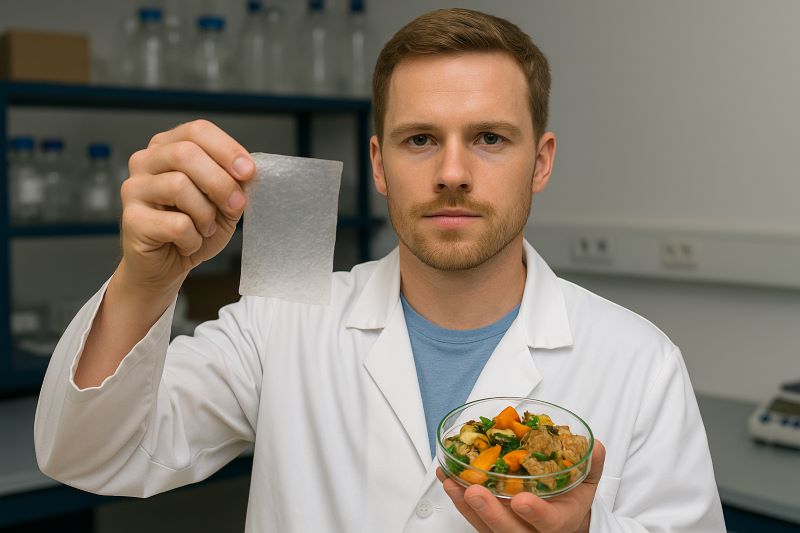
Against the backdrop of the increasingly severe global plastic pollution problem, a latest study from Binghamton University in the United States offers a brand-new approach to “waste treatment with waste”. Researchers have successfully synthesized a degradable natural film using sugars and organic matter from food waste, which is expected to replace traditional petrochemical plastic packaging materials in the future. This achievement has been published in the journal “Bioresource Technology” and has attracted extensive attention in the fields of materials science and environmental protection.
From garbage to resources: Innovative attempts in the dual environmental crisis
In recent years, plastic pollution has become a global environmental issue. Traditional plastic products are difficult to degrade and will decompose into microplastics once they enter the ocean, causing long-term harm to the ecosystem. At the same time, global food waste is also on an astonishing scale. According to statistics from the Food and Agriculture Organization of the United Nations, about one-third of food is wasted or discarded each year, generating a large amount of fermentable organic waste.
The research team from Binghamton University pointed out that if food waste can be transformed into reusable polymer materials, it will not only reduce the carbon emissions caused by landfill and incineration, but also simultaneously alleviate the problem of plastic dependence, achieving a “double reduction” of the environment and resources.
Technical approach: Utilizing microorganisms to synthesize degradable polymers
The research team adopted the technical route of “microbial fermentation + polymer synthesis”. First of all, they extracted fermentable sugars and fatty acids from food waste, and then input these substances as carbon sources into specific strains (such as Cupriavidus necator) to induce the synthesis of PHA (polyhydroxyalkanoates) – a natural polymer with biodegradable properties – under anaerobic fermentation conditions.
After purification and heat treatment, these PHAs are made into transparent films. Researchers have found that this new material not only has good tensile strength and flexibility, but also can be completely degraded in compost or soil environments. The experimental results show that the mechanical properties of this film are comparable to those of traditional plastic packaging films, and the degradation cycle only takes a few months.
Performance features: Thin and light, degradable, and customizable
Experimental data show that this natural film derived from food waste has a thickness ranging from 50 to 70 micrometers and can be “flexibly adjusted”, making it suitable for various packaging purposes. Its mechanical strength is stable, capable of withstanding a tensile stress of up to 30 megapascals, and it also features excellent air permeability and moisture resistance.
The research team was also able to control the physical properties of the film by altering the fermentation strains and reaction conditions. For instance, by adjusting the proportion of the PHA chain structure, the film can be made tougher or softer, thus adapting to different scenarios – such as food preservation film, agricultural film, or disposable packaging bags.
The core advantage of this film lies in its complete degradability. Experiments show that in a natural composting environment, it can be decomposed by microorganisms into carbon dioxide and water within 12 weeks without leaving any harmful residues. This property makes it a potential material to replace petroleum-based plastics.
Application prospects: From the laboratory to industrialization
The research team believes that this achievement is not only an important breakthrough in the field of environmental protection materials, but also provides a practical and feasible path for the “resource utilization of food waste”.
We hope to establish a sustainable circular model to turn wasted food back into useful resources for society. Professor Matthew Jones, the project leader, said, “In the future, we plan to collaborate with food processing enterprises to directly utilize production waste for PHA raw material fermentation.”
At present, the team is in talks with several biomaterials companies in the United States to explore the feasibility of pilot-scale amplification and commercial production. Researchers estimate that when produced on a large scale, the cost of each ton of film is expected to drop to about 70% of that of each ton of plastic. If the urban organic waste recycling system can be integrated into the supply chain, this kind of “food-based plastic” may enter the packaging, fast-moving consumer goods, and even 3D printing material markets in the future.
Challenges and prospects: Time is still needed from concept to implementation
Although this technology is considered promising, there are still many challenges before it can be used on a large scale to replace plastic. Firstly, the production cost and energy consumption of biodegradable materials are still higher than those of traditional petrochemical routes. Secondly, the composition of food waste in different regions is complex, and the quality of raw materials varies greatly, which may affect the fermentation efficiency and polymerization output. In addition, how to ensure that the products after degradation are completely harmless also needs further verification.
Experts point out that to truly achieve substitution, it requires the collaborative efforts of the government, industry, and scientific research. For instance, through policy subsidies and standard setting, enhance the competitiveness of biomaterials in the market; At the same time, strengthen the construction of the recycling system to ensure that degradable films can be effectively decomposed in an appropriate environment.
Global perspective: Green materials technology is accelerating its rise
In fact, many countries around the world are already exploring the “waste plastic alternative” route. A team from Monash University in Australia has also recently developed a new type of bioplastic from food waste sugar, which is naturally degradable and has a relatively low cost. Several chemical enterprises in Japan are developing PHA films using algae as raw materials. It is widely believed in the industry that the market size of biodegradable plastics will grow at an annual rate of more than 10% in the next ten years.
Experts commented that this research from the United States “combines scientific innovation with social significance”. If it can be successfully industrialized, it is not only expected to reduce plastic pollution but also may reshape the global landscape of waste management and packaging industries.
Conclusion
From discarded food scraps to transparent, eco-friendly films, this research demonstrates the creativity and potential of technology in the “green transition”. Scientists have told us through experiments that garbage is not the end but might be the starting point of a new materials revolution. In the future, with the emergence of more sustainable technologies, we may truly be able to bid farewell to traditional plastics and turn “leftover food” into a new force for protecting the Earth.





Leave a comment