Tokyo’s Miyashita Park stands as a compelling case study in urban renewal—one shaped by years of public debate, stakeholder negotiations, and the delicate balance between private interests and public good. What began as a contested open space has evolved into a mixed-use landmark, reflecting the complexities of reimagining urban landscapes in dense, dynamic cities like Shibuya.
A Troubled Predecessor: Tensions Before 2011
Prior to its 2011 reconstruction, Miyashita Park existed as a public open space grappling with mounting challenges. A growing population of unhoused residents had made the park their de facto home, while aging facilities and lagging maintenance exacerbated its decline. New seismic safety standards further highlighted the inadequacies of the existing structures, creating an urgent need to rethink the space’s purpose and functionality.
This scenario mirrored similar tensions in other urban parks globally, such as Berkeley’s People’s Park. Legally designated as public spaces, these sites often evolved into informal sanctuaries for marginalized groups, establishing unwritten norms and social boundaries. While providing a crucial safety net for those excluded from formal systems, this “soft enclosure” conflicted with the expectations of other visitors seeking a casual recreational area. By the early 2010s, Miyashita Park’s dual identity as a shelter and a leisure spot had become irreconcilable, setting the stage for redevelopment.
Contested Reconstruction: Protests, Art, and Legal Battles
The 2011 redevelopment plan sparked widespread controversy from its inception. Shibuya Ward sold the park’s naming rights to a private corporation in exchange for full funding of the renovation, tasking architecture firm Atelier Bow-Wow with the challenging redesign. Central to the project’s tension was the forced relocation of the unhoused community that had resided there for years—a move framed as necessary to create a well-maintained public space accessible to all.
Community resistance emerged on multiple fronts. Artists, activists, and local supporters opposed the plan, criticizing the private sector’s involvement, the ward government’s decisions, and the design firm’s role. Protest actions included video documentaries, media interviews, blog campaigns, construction blockades, and legal challenges. Notably, the resident artist collective A.I.R. Miyashita Park documented the entire protest movement, preserving testimonies and debates in an online archive that remains accessible to the public, officials, and designers. Despite the imbalance of power, community advocates ensured their voices were recorded and considered throughout the process.
A Transitional Phase: Laying Groundwork for Renewal
The pressures of public opposition reshaped the architecture’s trajectory, prompting funders, designers, and officials to reevaluate management models, planning strategies, and financing mechanisms. The goal shifted toward creating a space that served the broadest possible public while addressing long-term maintenance needs. However, the reconstruction also involved the painful clearance of informal encampments, displacing residents amid broader urban trends—rising prosperity, soaring living costs, and wealth concentration—that marginalize economically vulnerable communities.
The Nike-Atelier Bow-Wow designed park endured for less than a decade, but its short, turbulent existence played a critical transitional role in reconciling the city with its community. During this period, opponents and unhoused residents secured partial legal victories, laying the groundwork for a more ambitious, balanced, and financially sustainable redesign. This interim phase proved pivotal in aligning diverse stakeholder interests and setting the stage for the park’s current iteration.
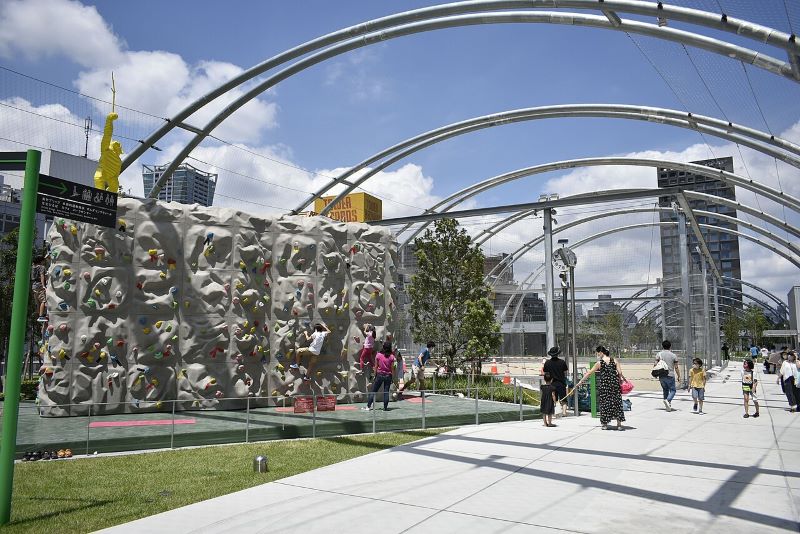
2025 Transformation: A Mixed-Use Public-Private Landmark
Today, Miyashita Park has emerged as a popular destination for tourists and locals alike. Redesigned by Nikken Sekkei and constructed by Takenaka Corporation, the upgraded public-private partnership features seismically resilient buildings, an elevated public space, and comprehensive infrastructure improvements. The three-story retail podium houses high-end brands, while a new hotel tower caters to Shibuya’s booming tourism and capital inflow.
Critics note the park’s overt commercialization, arguing that the grassroots, community-driven public spirit of its earlier form has been replaced by a meticulously managed environment that implicitly screens users. Nevertheless, through careful event programming, adaptive management, and cost control, the park has largely achieved its vision of balancing diverse operational pressures while serving a wide audience. As few urban spaces can truly cater to all, Miyashita Park’s ability to accommodate multiple user groups stands as a notable achievement.
Beyond a Park: Urban Renewal Lessons
Miyashita Park’s nearly two-decade evolution—spanning two major renovations—offers profound insights into urban renewal, the evolving meaning of “publicness,” and diversified financing for urban infrastructure. Its complex journey highlights the difficulties of reconciling conflicting interests and the value of sustained civic engagement. The project raises broader questions about the roles of public and private sectors, long-term management structures, and the balancing of competing uses in limited urban spaces.
Like many global cities, Shibuya faces pressures to pursue economic growth while addressing affordable housing and equitable access to public resources. Miyashita Park’s transformation reflects these tensions: viewed one way, it delivers widespread benefits—tourism, commerce, jobs, and daily amenities; viewed another, it redefines notions of belonging and access. Ultimately, the park’s significance lies not in being judged a success or failure, but in serving as an ongoing reference point. It reveals the inherent trade-offs in contemporary urban redevelopment, highlights whose voices are amplified or silenced, and underscores the continuous effort required to align shared spaces with evolving urban life.