


January 26 marks the International Day of Clean Energy, an initiative raising awareness and driving inclusive transition from fossil fuels like coal, oil and gas to power systems with lower greenhouse gas emissions and fewer pollutants. The shift to clean energy represents a fundamental move from extractive, finite resources to systems based on renewable sources and natural energy processes. It plays a key role in cutting emissions and expanding reliable power supply amid global climate change efforts, yet it still brings impacts during production, deployment and commercialization. The UN stresses that ending fossil fuel reliance is vital to limit climate change, and buildings must rely on clean, accessible, affordable, sustainable and reliable energy for heating, lighting and power.
Greenhouse gas emissions, a major driver of global warming, are largely generated by energy production, especially fossil fuel combustion for power and heating. Global inequities in energy infrastructure worsen this challenge, with many regions still dependent on polluting fuels. This reliance perpetuates poverty by limiting access to education, healthcare and economic opportunities due to insufficient reliable power. Urban planning and architecture not only help expand energy supply, supported by rising per capita renewable energy installed capacity, but also boost energy efficiency through advanced technologies in transport, construction and lighting that deliver the same output with less consumption. A fair and effective energy transition requires understanding how different energy sources operate, their integration into the built environment and their environmental impacts.
Two design-focused approaches have emerged globally to address energy-related impacts as nations, cities, industries and communities step up climate action: one examining regional energy production and distribution, and the other focusing on energy-related buildings and technical equipment.
Regional Impacts of Clean Energy Access
Mainstream clean energy comes from renewables including wind, solar, geothermal and hydropower, with ocean and bioenergy recognized by the UN. All these require new infrastructure for energy capture, processing, transportation and use. Despite their “clean” label, they often demand large-scale use of scarce resources such as land and water, leading to so-called “sacrifice zones”. These areas, mostly home to low-income groups, face permanent physical and environmental degradation, eroding living standards. Impacts range from direct changes to living environments’ visual and acoustic conditions to indirect harm to ecological balance via biodiversity loss, making sacrifice zones a symbol of persistent, even cross-border, regional inequality.
To tackle these issues, there is a growing shift to localized, less intrusive infrastructure solutions guided by circular thinking, which reduces the need for long-distance resource extraction and transportation. Recent examples highlight this trend: Bahrain’s National Pavilion, winner of the Golden Lion for Best National Participation at the 2025 Venice Architecture Biennale, features passive cooling technologies for public spaces. Henning Larsen’s KlimaKover offers a modular, low-energy system for thermal comfort without mechanical refrigeration, while MVRDV’s SOMBRA Pavilion in Venice explores dynamic environmental adaptability. On a larger scale, Finland integrates waste heat from local cryptocurrency mining into district heating systems, warming homes for 80,000 residents and cutting reliance on traditional boilers significantly.
Product Impacts of Energy Transition Tech
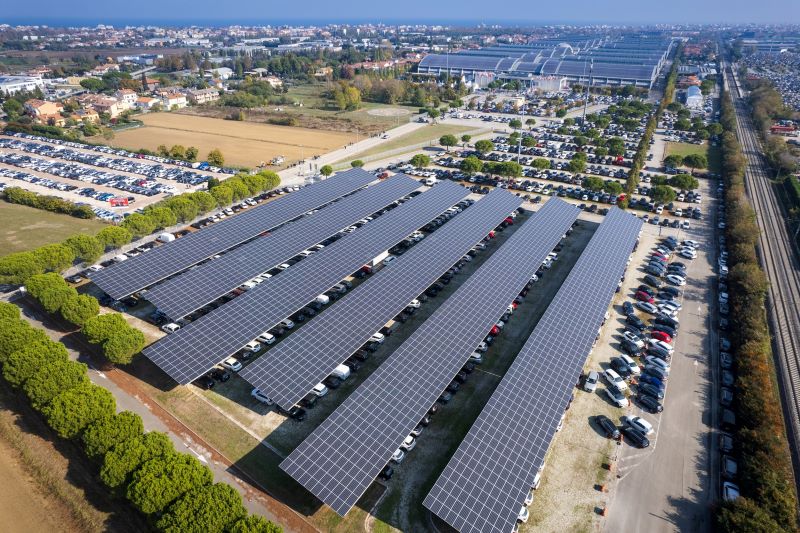
Renewable energy technologies have also entered daily life via products and building-level applications, with photovoltaic panels, wind turbines and batteries serving as key interfaces for energy capture, storage and consumption, closely linking to the construction industry. Though seen as environmentally friendly, these products carry environmental and economic costs related to materials, manufacturing, maintenance and disposal. They rely on critical minerals, composite materials and complex supply chains, creating new cycles of consumption, replacement and waste. The rapid scaling of renewables, driven by falling costs and improved accessibility, underscores the need to assess their full-life-cycle impacts instead of assuming they are entirely harmless.
Initiatives are emerging to address these product-related challenges. Solar panel recycling programs recover glass and other components, alleviating the growing problem of photovoltaic waste and extending material lifespans. In the wind sector, the UK has tested painting turbine blades black to reduce bird collisions, demonstrating eco-friendly design adjustments without compromising energy output. The University of Sheffield is developing flexible thin-film solar cells that expand energy-generating surfaces, cut material use and integrate with existing building structures. For the architecture industry, integrating such products requires managing consumption, environmental adaptation and degradation over time, with reuse, adaptive design and material innovation being as important as their power-generation capacity.
There is no zero-impact energy source, yet circular design and thinking offer sustainable solutions that make energy extraction far less destructive than fossil fuel mining. Regional strategies involve integrating community-led medium-scale initiatives to address local challenges creatively, while material-level solutions focus on product innovation and redefined consumption based on updated views of product lifespans. From large-scale infrastructure to community-level projects, and from immediate actions to long-term planning, global initiatives are shaping concrete, resilient energy transition strategies that remain effective amid technological shifts like artificial intelligence.


