

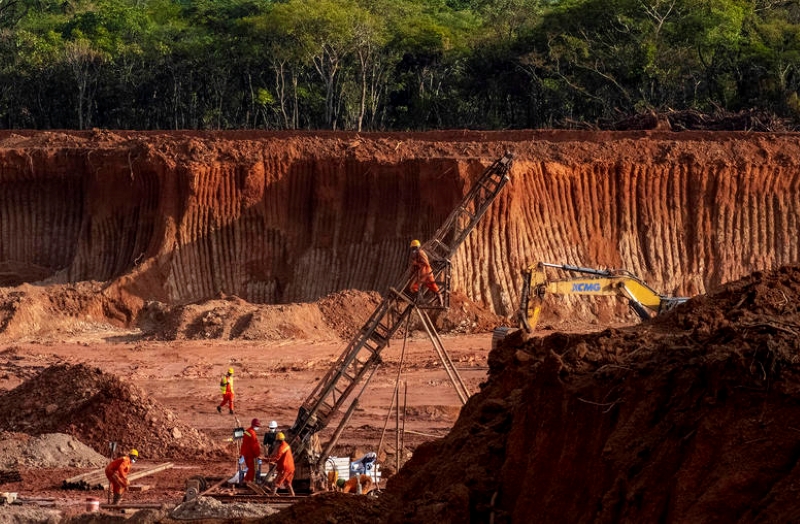
On August 22, the Ninth Tokyo International Conference on African Development concluded in Yokohama, Japan, with critical minerals emerging as one of the central topics. In recent years, countries such as the United States, the European Union, Australia, the United Kingdom, the United Arab Emirates, and India—alongside Japan—have all joined the strategic competition for Africa’s critical minerals in hopes of securing sufficient supplies for their own industries. Yet, can they truly help Africa develop its abundant resources and support the region’s industrial upgrading? With 30% of the world’s critical mineral reserves, what development strategies have African countries put in place, and what impacts will these strategies have on other nations?
Many Countries Want to Join the African Metals Club
“Japan and African nations have agreed to cooperate in ensuring a stable supply and ‘responsible development’ of critical minerals on the resource-rich African continent.” This August 22 report by Kyodo News on the Ninth Tokyo International Conference on African Development highlighted Japan’s eagerness for Africa’s critical minerals. AFP was even more direct in its coverage, saying that during the conference between the Japanese Prime Minister and African leaders, the focus was clearly on artificial intelligence and critical minerals.
Japan’s attention to Africa’s critical minerals did not begin this year. In 2023, Jeune Afrique published an article titled “From Congo (DRC) to Madagascar, Japan Weaves a Web with Critical Metals”, noting that Tokyo was launching a charm offensive across the African continent in hopes of securing a seat in the “African Metals Club.” Japan’s NHK television also reported that year on Tokyo’s resource diplomacy toward Africa. In August 2023, then Minister of Economy, Trade and Industry Yasutoshi Nishimura visited five African countries, including the Democratic Republic of Congo and Namibia. “The crucial mission Nishimura carried on his long journey to Africa,” NHK wrote, “was to secure access to critical mineral resources that will shape the future of Japan’s core industries.”
Al Jazeera commented, “Trump meets leaders of five African nations, with an eye on their precious minerals,” referring to U.S. President Donald Trump’s July 9 meeting at the White House with leaders from Liberia, Senegal, and other African countries. During his first term, Trump had insulted African nations with crude language, but when it comes to critical minerals, his stance toward Africa has undergone a dramatic reversal. At the U.S.–Africa summit, the president declared that the participating countries “possess extraordinarily precious soil, abundant minerals, vast oil reserves, and great people.”
In June this year, the U.S. brokered a peace agreement between the Democratic Republic of Congo (DRC) and Rwanda, aiming to end conflict in eastern Congo. According to Radio France Internationale, the accord carries deeper economic and geopolitical implications. At the heart of both the regional conflict and international competition lie Congo’s mineral resources. Ending hostilities would open the door for U.S. private companies to expand investments there. Recently, KoBold Metals, a mining company backed by American billionaires Jeff Bezos and Bill Gates, announced it would expand operations into the DRC.
Even under President Biden, the U.S. had already been ramping up investment in African minerals. Its flagship project is the “Lobito Corridor,” a 1,300-kilometer railway stretching from Zambia to Angola, designed to transport cobalt, copper, and other critical minerals from deep inland Africa to coastal ports. Once completed, a journey that currently takes more than 40 days by road will be cut to just 40 hours. At the end of last year, the Biden administration pledged $4 billion for the project. In April this year, a U.S. diplomat revealed that the Trump administration remained committed to funding the Lobito Corridor.
The European Union is also actively positioning itself in the scramble for Africa’s critical minerals. In March, the 8th South Africa–EU Summit was held in Cape Town, where both sides agreed to strengthen cooperation in key sectors, including critical minerals. In June, Radio France Internationale reported in an article titled “Africa’s Critical Minerals: Europe Steps Up in the Resource Game” that the European Commission has identified 60 strategic metal projects, including four in Africa: the Songwe Hill rare earths project in Malawi, the Zandkopsdrift project in South Africa, the Maniry project in Madagascar, and a planned cobalt refinery in Zambia. European investors hope to secure supplies of rare earths, graphite, and other key minerals. These projects are eligible for financial support from an EU task force that brings together institutions such as the European Investment Bank and the European Bank for Reconstruction and Development.
“Other countries have also joined this strategic race.” According to an article by the Atlantic Council, Canada, South Korea, India, the UAE, and others have increased investment in Africa due to its critical minerals. Canada has poured significant funds into exploration and development projects, focusing on cobalt, copper, and lithium. More than 145 Australia-listed mining companies are operating nearly 500 mines in 34 African countries, with Tanzania being a recent investment hotspot. Between 2022 and 2024, Australian firms acquired over 90% of new exploration licenses in Tanzania. In recent years, the UK has established partnerships with South Africa on critical minerals and signed a Green Growth Compact with Zambia, a major producer of copper, cobalt, manganese, and nickel.
The UAE’s investments have centered on copper-rich Zambia and the DRC. Since 2021, it has also deepened economic ties with Angola, known for its vast reserves of copper, cobalt, manganese, and lithium. The Arab Gulf States Institute in Washington reports that Saudi Arabia has been actively seeking mineral deals in Africa, pledging in 2023 to invest $10 billion in mining projects there over the next five years. In January 2024, Saudi Arabia signed mining investment MoUs with the DRC, Egypt, and Morocco. India, too, is negotiating mining cooperation and access agreements with several African nations, including the DRC, Malawi, and Madagascar. New Delhi has already signed MoUs with six African countries to secure supplies of cobalt, nickel, and other minerals.
Notably, countries such as Australia and Canada are not only signing agreements with African states but are also building cooperation frameworks with one another. In September 2023, the UK and Japan established a joint framework to invest in African mineral development. As Nikkei noted, Britain has long-standing ties with Africa through the Commonwealth, and Japan is looking to leverage the UK’s networks on the continent to secure its own interests.
Africa Is at the Forefront of the Energy Transformation Era
“The energy transition has fueled a global scramble for critical minerals, turning elements such as lithium, cobalt, and rare earths into strategic assets,” wrote a recent article published by Project Syndicate. According to African Business magazine, demand for critical minerals has surged amid accelerating energy transitions, sparking intense geopolitical competition over these resources. The Carnegie Endowment for International Peace, citing International Energy Agency (IEA) data, noted that by 2040, the energy sector’s demand for lithium will be 40 times higher than in 2020, graphite 25 times, and nickel and cobalt 20 times.
As reported by Al Jazeera and other outlets, Africa’s vast natural wealth makes it one of the richest continents and a major stage in the intensifying global competition for strategic minerals. The continent holds about 30% of the world’s critical mineral reserves. The Democratic Republic of Congo alone accounts for roughly 47% of global cobalt reserves, 15% of rare earths, and 60% of coltan. South Africa, along with Gabon and Zimbabwe, possesses 80% of the world’s chromium, 85% of its manganese, and 80% of its platinum. Zimbabwe and Mali are key lithium producers, while South Africa supplies 80% of the world’s iridium.
These abundant resources bring Africa major economic benefits. Al Jazeera notes that Africa is the world’s third-largest destination for mining investment after Latin America and Canada. Between 2018 and 2022, the region attracted about $77 billion in foreign direct investment (FDI) in the mining sector, accounting for roughly 13.9% of its total FDI inflows.
Growing numbers of countries are paying closer attention to Africa. In December 2022, Australia’s then Assistant Foreign Minister visited Ghana, South Africa, and Morocco—the first such trip to the continent by a senior Australian diplomat in six years. In June 2024, South Korea hosted its first-ever Korea–Africa Summit in Seoul, seeking deeper ties with mineral-rich nations. The summit launched a “Korea–Africa Critical Minerals Dialogue” mechanism.
According to Modern Diplomacy, Africa is at the forefront of the energy transformation era. As global competition for critical minerals accelerates, the continent finds itself at a pivotal crossroads. Decisions made in the coming years will not only reshape Africa’s economic landscape but also influence the geopolitics of global resource competition.
“Africa has become one of the centers of international diplomacy, with its global standing and influence on the rise. This offers the continent an opportunity to emerge as a strategic player in global supply chains, allowing African nations to leverage their bargaining power in the competition over critical resources,” reported the South African Broadcasting Corporation. Africa News added that many African nations are seeking closer engagement with Western countries, and that the race for critical minerals provides a geopolitical window of opportunity. African leaders, it said, must shift from being “pursued” to leading the dialogue—turning resources into tangible outcomes, maintaining global attention, and maximizing Africa’s advantages.
Experts point out that Washington’s recent summit with African leaders—after having cut much of its aid to Africa—reflects not support for the continent’s development needs but rather a selective interest in resource-rich partners.
In April this year, media outlets obtained a draft U.S. State Department reorganization plan indicating that the White House may close numerous embassies and consulates in Africa, retaining only a limited number of offices to handle key matters—including securing access to the continent’s “critical natural resources.”
What Africa Wants Is Jobs, Not Just Dollars
Africa is often described as a “treasure trove” of critical minerals, yet the continent still faces significant challenges in developing them—one of the biggest being regional instability. A May article by the Center for Strategic and International Studies (CSIS) noted that Mozambique holds the world’s third-largest graphite reserves, but violent conflict in the country’s northern Cabo Delgado province has sharply curtailed mineral exploration. The conflict, which began in October 2017, remains one of southern Africa’s most serious security challenges. Similarly, political instability in the Sahel has hampered mining investment. In Niger, exploration spending has plummeted by 89.8%, from $66.4 million in 2012 to just $6.8 million in 2024.
Can Western nations help unlock Africa’s mineral potential? The U.S. and EU hold several advantages in African mining investment, such as flexible financing tools and more mature industrial linkages. However, their projects are often slow to approve and face high implementation uncertainty. An article published by the London School of Economics stressed that one major obstacle to increasing Africa’s mineral value-addition is the reluctance of developed countries to transfer technology or repay their historical climate debts. Meanwhile, the U.S., leveraging its market power—especially through legislation like the Inflation Reduction Act—has secured strategic advantages in the global minerals race. Yet this approach has also been criticized as a form of “green neocolonialism,” which risks excluding African nations from the more profitable segments of the value chain. The “Lobito Corridor,” for instance, may guarantee U.S. mineral supplies but could sideline Africa from higher-value processing and manufacturing.
“Africa wants its critical minerals to generate jobs, not just dollars.” According to a recent Wall Street Journal report, as global demand for critical minerals surges, many African nations are tightening restrictions on raw mineral exports, seeking instead to process resources domestically. This move aims to boost employment, increase export revenues, and foster local industrial growth. The OECD notes that in the past two years, nearly half of Africa’s 54 countries have imposed restrictions or outright bans on raw material exports. Nigerian media also report that African mineral-rich nations are shifting from passively exporting raw resources to proactively driving regional cooperation in order to control their own development path.
According to the South African Broadcasting Corporation, African governments now hold greater leverage in negotiations as foreign powers compete for access to critical minerals. This allows them to secure more favorable terms—ensuring cooperation translates into jobs, infrastructure improvements, and sustainable economic growth. Nigerian outlets add that the African Minerals Strategy Group, created by more than a dozen countries, continues to expand. Member states hope the group will help them achieve collective development while breaking free from dependence on raw resource exports.




Leave a comment