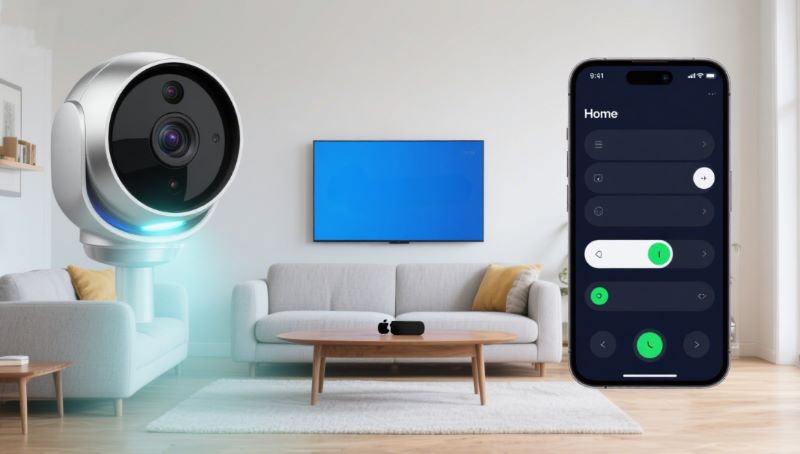
At a pivotal stage in the AI race among tech giants, Apple is redefining the boundaries of smart homes with a series of groundbreaking products. From a desktop robot that can proactively track users to a smart voice assistant capable of multi-turn conversations, and a full-range home security system, Apple is deploying a combination of “hardware materialization + deep AI integration + ecosystem closure” to make significant strides in the AI and home security space.
This strategy is not just about individual product innovation, but also about Apple’s ambition to reshape human-computer interaction and build the next-generation smart ecosystem. By deeply integrating cutting-edge technologies with everyday home scenarios, Apple aims to transform smart devices from cold, utilitarian tools into warm, interactive life companions that offer a new tech experience for users.
Desktop Robot: The Core Vehicle for AI’s Shift from Virtual to Physical
Apple’s upcoming desktop robot, code-named J595, slated for release in 2027, stands as the “physical embodiment” of its AI strategy. Resembling an iPad equipped with a movable robotic arm, this device breaks the traditional static interaction model of smart devices and turns AI into a tangible “virtual companion.” Its main strength lies in its ability to actively respond to user needs—using its rotating and moving mechanical arm, the robot can precisely track the speaker in the room. During FaceTime calls, it can automatically lock onto the person’s position, and even allow users to remotely control the robot through their iPhone to showcase room details, making video communication evolve from a “fixed perspective” to an “immersive interaction.”
What stands out even more is its humanoid interaction design. The robot’s new version of Siri not only has multi-turn conversational capabilities but also proactively engages in discussions about topics like family restaurant recommendations or travel planning. With the “Bubbles” visual avatar enhancing emotional connection, the initial test design used a Finder icon animation, making voice interaction feel more “expressive.” Equipped with a front-facing camera that supports facial recognition, the device can automatically switch interface layouts and personalized content for different users. The Charismatic operating system, designed specifically for multi-user scenarios, combines the large-screen interaction of Apple TV with the convenience of Apple Watch, ensuring that both the elderly and children in the household can easily use the device. This project represents a collaboration between Apple’s AI, hardware, and software teams, and even draws inspiration from a 2024 robotics and lighting research paper, showcasing Apple’s deep technical expertise in turning cutting-edge technology into consumer products.
Siri Reborn: From Functional Tool to the Smart Hub of the Home
As the “voice gateway” to Apple’s ecosystem, Siri’s comprehensive upgrade has become the key link between hardware devices and user demands. This transformation is a gradual, multi-stage process aimed at evolving Siri from a “passive command executor” into the “active intelligence” at the center of the home. By the end of 2025 or early 2026, the “Apple Smart” update through iOS will make significant strides, improving natural language understanding precision and even incorporating screen recognition, with integrations into ChatGPT, providing users with richer conversational feedback.
The “LLM Siri” scheduled for release in Spring 2026 will mark a major architectural overhaul. Based on the “App Intents” framework, this update will allow users to control third-party apps through voice commands—everything from ordering an Uber to playing a Spotify playlist—without needing to touch the screen. Early tests show a context understanding accuracy of 89%, meaning users can complete multi-step tasks using more natural spoken language. By 2027 and beyond, Siri, powered entirely by Apple’s in-house models, will experience a qualitative leap, capable of proactively initiating interactions and handling complex cross-app tasks, with capabilities rivaling ChatGPT. Behind this upgrade is the collaboration between Apple’s Neural Engine chip and software algorithms, with engineers frequently drawing insights from the development of ChatGPT and Google Gemini to accelerate iterative learning.
Home Security Ecosystem: From Single-Point Monitoring to Scenario-Based Protection
Home security, as the core scenario of smart homes, is a crucial part of Apple’s ecosystem strategy. The J450 home security camera, planned for release in 2026, will redefine home security experiences. Equipped with advanced facial recognition and infrared sensors, the camera will not only accurately identify family members but also integrate with the HomeKit ecosystem to automate entire scenarios. For instance, when it detects that a user has left a room, it will automatically turn off the lights, play personalized music according to different family members’ preferences, and even trigger an alarm if an intruder is detected. With a battery-powered design offering months of battery life, combined with 24/7 indoor and outdoor surveillance capabilities, it directly competes with Amazon’s Ring and Google’s Nest in the market.
Apple’s home security strategy is far from relying on a single device; instead, it creates a full loop, from front-end perception to back-end services. Devices are deeply integrated with iCloud and subscription services to ensure encrypted cloud storage and data security. With Apple TV or iPad acting as the smart hub, users can extend their security system with multiple devices interacting seamlessly. Additionally, the face-recognition-enabled smart doorbell, currently in testing, will further fill the security gap at the doorstep. More importantly, these devices all run on the Charismatic operating system, emphasizing voice interaction and widget functionality, reducing reliance on traditional apps and thereby building a high user-retention ecosystem. By acquiring companies like Lighthouse AI to strengthen its technical capabilities and developing the “Linwood” language model for enhanced scene recognition, Apple is embedding AI deeply into every facet of home security, transforming technology into an “invisible guardian” of the home.
From the materialized interactions of the desktop robot to Siri’s evolution into a smart assistant, and the construction of a closed-loop home security ecosystem, every step of Apple’s strategy points toward one goal: to transform AI from an abstract technical concept into a tangible, everyday experience. As CEO Tim Cook has stated, AI is an area where Apple “must win.” These products’ eventual release will not only reshape Apple’s innovative image but could also redefine the relationship between humans and technology—perhaps in the near future, smart devices will no longer be cold tools but will instead become “family members” that understand, accompany, and protect us.