

WAF 2025 Building of the Year Winner Announce
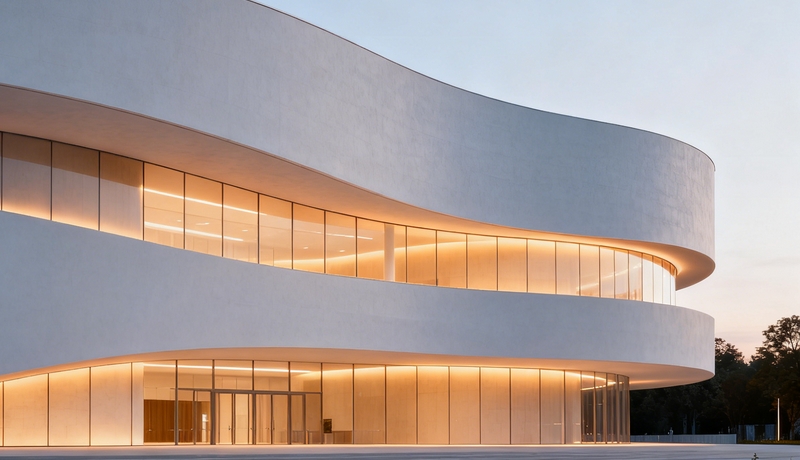
At the recently concluded World Architecture Festival (WAF) 2025, the Holy Redeemer Church and Community Centre of Las Chumberas in Laguna, Spain, emerged victorious from a global field of contenders to claim the highest honor of “World Building of the Year.” Designed by Fernando Menis Architects, this structure defeated hundreds of shortlisted projects from 37 countries to become the festival’s most celebrated star.
Project Background & Community Context
Designed by architect Fernando Menis, this project is located in La Laguna, Canary Islands, Spain. It combines a church, community center, and public plaza, aiming to inject new public and social vitality into the once-neglected peripheral community of the area.
Unlike many buildings that rely on flashy forms or high-tech materials, this church emphasizes simplicity, honesty, and locality. Its massing is solid and its texture unadorned. Specifically, the design draws inspiration from the local volcanic landscape, featuring a “rough, primitive” concrete form with visible textures and natural patterns that create a strong visual dialogue with the surroundings.
More significantly, its construction was entirely funded through community donations, with phases completed as funds became available. The initial community center section was finished and operational within two years, while the remaining structures were gradually built over the following decade. This model of “grassroots funding plus incremental construction” not only embodies community intent and participation but also ensures the building truly becomes the community’s “shared asset”—not merely a “design piece.”
Design Strategy & Spatial Experience
The interior design of the church treats natural light as a key element, abandoning traditional windows entirely in favor of a skylight at the top and a glassless cross-shaped opening that introduces light from above. As the position and intensity of light shifts throughout the day, the atmosphere within the space evolves—sometimes solemn and reverent, other times warm and gentle. Light and shadow together shape an ambiance that is both spiritual and meditative.
Concrete serves not only as a structural material but also fulfills multiple functions, including formal beauty, tactile quality, and acoustic performance. Reports indicate that volcanic rock slag was mixed into the concrete, enhancing thermal and acoustic properties while imparting the space with theater/opera house-like acoustic qualities.
Architecture with Social Impact
The jury’s assessment of this project lies precisely in how it balances “symbolic and spiritual needs” with “everyday community functions.” On one hand, it fulfills religious, spiritual, and symbolic significance. On the other, it serves as a community center + public plaza, providing residents with tangible gathering and interaction spaces. As the jury noted, they “appreciate the architectural tension and how light shapes the quality and texture of the interior spaces.”
From a broader perspective, it also reflects a contemporary architectural trend: a return to “local identity, material honesty, social engagement, and public value” rather than the mere pursuit of iconic status and commercial appeal. For architects and urban designers, this offers a meaningful insight: good architecture need not be expensive, luxurious, or technically showy; it can be honest and unpretentious while genuinely responding to people’s lives, communities, and emotional needs.
The key message conveyed by the 2025 WAF through the Holy Redeemer Church project is that architecture transcends mere form and aesthetics—it embodies society, community, and humanity. A church and community center built through grassroots funding and community participation can revitalize a once-marginalized neighborhood, bringing “neglected” spaces back into the public eye.
In an era of accelerating globalization and urbanization, perhaps what we need most are buildings that do not flaunt status or pursue dazzling exteriors. Instead, they remain grounded, responding to human needs through architecture and nurturing communities and society through space.


Related Articles

Local Moves for Clean Energy’s Spatial Impacts
January 26 marks the International Day of Clean Energy, an initiative raising...

Architecture’s Blue Notes: Tension and Subtle Deviations
The pentatonic scale, a musical framework built from just five notes, creates...

Niall McLaughlin to Win 2026 RIBA Royal Gold Medal
The Royal Institute of British Architects has named Irish architect, educator and...


Composites Reshape Modern Architecture Globally
Once confined to aerospace and automotive industries, composite materials have emerged as...