

Claude Vs. ChatGPT: Top-Tier AI Models Move Toward Differentiation
The global market is witnessing a clear AI trend of user group differentiation. The latest data from OpenAI and Anthropic, two major industry leaders, shows that ChatGPT is becoming the first choice as a personal life assistant, while Claude dominates in enterprise automation deployment.
In its latest research report, Barclays stated that data reveals Anthropic’s API business accounts for as high as 90% of its total revenue, far exceeding OpenAI’s 26%. This highlights Claude’s strong position in the B2B (business-to-business) market.
User behavior analysis further confirms this differentiation trend. According to the Anthropic Economic Index Report, 77% of Claude’s usage scenarios are concentrated in commercial applications, and 36% are specifically for programming tasks, demonstrating distinct enterprise-level characteristics. In contrast, OpenAI’s research shows that 73% of ChatGPT’s use cases are unrelated to work, with the model serving more as a personal assistant.
Analysts point out that the world’s two top-tier AI models are taking distinctly different commercial paths. Leveraging its advantages in API (Application programming interface) integration and enterprise automation, Claude is reshaping the landscape of B2B AI services, while ChatGPT continues to consolidate its leading position in the consumer market.
Claude Establishes a Leading Edge in the API Market
Revenue growth data underscores Claude’s strong momentum in the B2B market.
Anthropic’s API business generated $512 million in revenue in 2024 and is expected to surge to $3.907 billion in 2025, representing a year-on-year growth of 662%. In comparison, OpenAI’s API business recorded $1 billion in revenue in 2024, with a projected increase to $1.8 billion in 2025, translating to a growth rate of 80%.
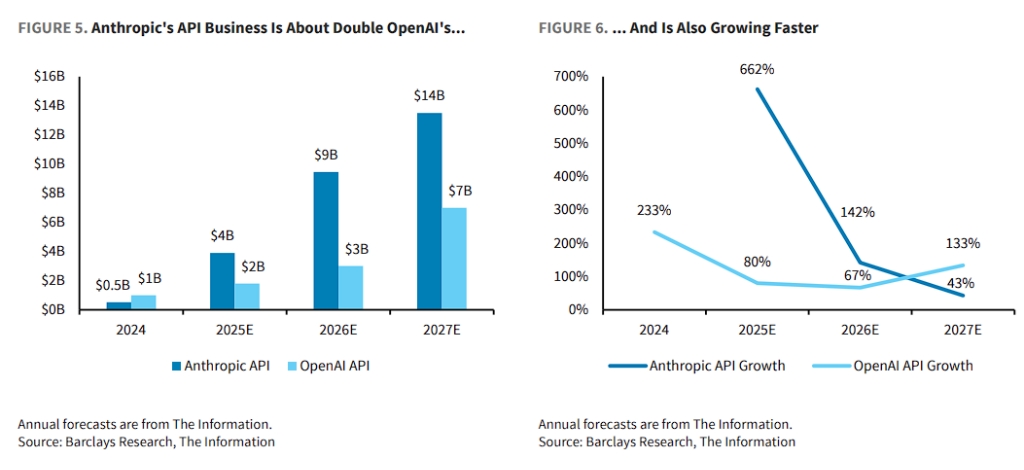
Analysts note that this difference in revenue structure reflects the distinct strategic focuses of the two companies. Claude concentrates on providing enterprises with programmably integrable AI capabilities, while ChatGPT relies more on a consumer service model based on subscriptions.
Differentiated Usage Scenarios Confirm Differences in Business Positioning
User behavior data further validates the distinct positioning of the two AI models. According to the Anthropic Economic Index Report, Claude users exhibit obvious commercial characteristics: 77% of usage scenarios involve commercial applications, and 36% are dedicated to programming tasks. Among API clients, this trend is even more pronounced, with 77% of enterprises adopting an automated usage model, primarily for task delegation rather than collaborative interaction.
OpenAI’s research paints a completely different picture. An analysis of 1.5 million user chat records shows that non-work-related use has become the primary application scenario for ChatGPT. In June 2024, work and personal use were roughly evenly split, but by June 2025, non-work use accounted for 73% of all conversations. Among the categorized conversations (exceeding 1 million), “practical guidance” accounted for 28.3%, covering personal needs such as daily advice, academic assistance, and fitness guidance, while writing assistance ranked second.
The difference in the frequency of programming task usage is also revealing. 36% of Claude users engage in programming-related work, whereas only 4.2% of ChatGPT users’ conversations involve programming, further highlighting the differentiation in their target user groups.
Enterprise Demand for Automation Drives Claude’s Growth
Claude’s success in the enterprise market stems from its accurate grasp of automation needs.
API data shows that enterprise clients mainly use Claude for programmably integrated task execution, rather than collaborative human-AI interaction. This usage model is highly aligned with enterprises’ pursuit of efficiency and scalability.
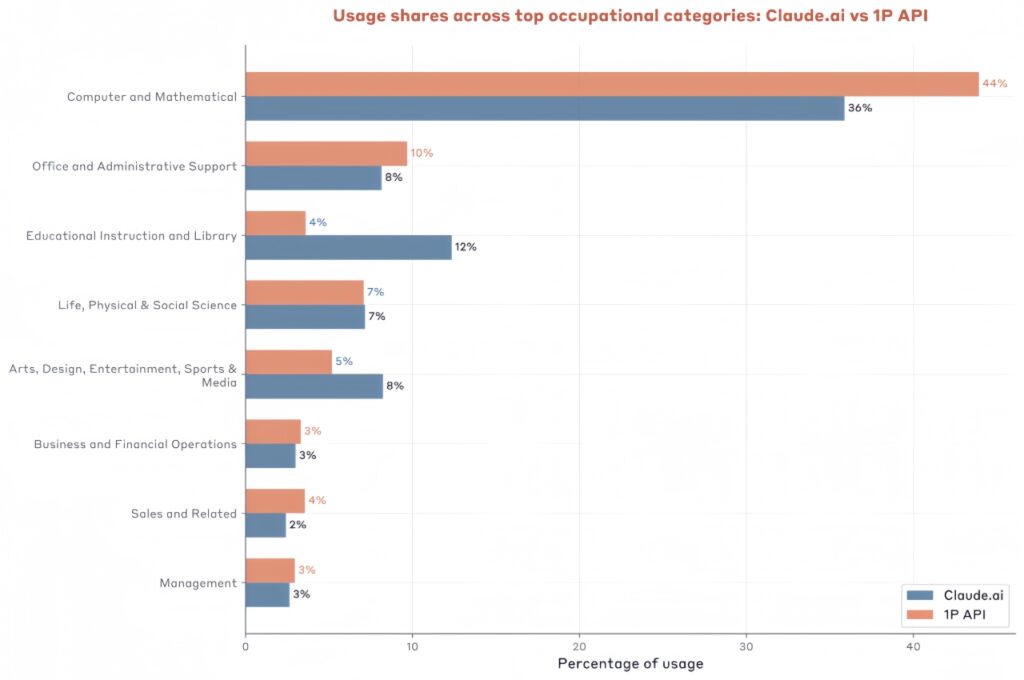
In terms of task distribution, 44% of Claude’s API clients’ usage is concentrated on computer and mathematical tasks, significantly higher than the 36% on the Claude.ai platform. Meanwhile, office and administrative tasks account for approximately 10%, reflecting strong enterprise demand for automated office solutions. Enterprises also deploy Claude in areas such as marketing material creation and business recruitment data processing.
Surprisingly, enterprises show relatively low sensitivity to AI usage costs. A 1% increase in costs leads to only a 0.29% decrease in usage frequency, indicating that model capabilities, ease of deployment, and economic value are more important than costs. More expensive tasks often have higher usage rates; for example, computer and mathematical tasks cost over 50% more than sales-related tasks, yet they dominate in terms of usage volume.
Differentiated Technical Capabilities Shape the Competitive Landscape
The different focuses of Claude and ChatGPT in terms of technical capabilities are shaping their respective competitive advantages.
Claude excels in code generation, debugging, and technical problem-solving, which is closely linked to its success in the API market. The rapid adoption of new tools by the developer community and the relatively low organizational barriers for individual developers have laid the foundation for Claude’s enterprise-level applications.
ChatGPT, on the other hand, has greater advantages in information retrieval and personal guidance. “Information search” has become ChatGPT’s third-largest usage scenario, with users viewing it as an alternative to web search. Analysts suggest that this application model poses a potential challenge to traditional search engines like Google and creates opportunities for OpenAI to explore new revenue streams such as advertising and e-commerce recommendations.
The differences in human-AI collaboration models between Claude and ChatGPT also deserve attention. Claude users tend to delegate complete tasks to the AI for execution, reflecting enterprises’ preference for automation. In contrast, ChatGPT users more frequently engage in collaborative interactions, which aligns with individual users’ needs for learning and exploration.
In summary, through the differentiated deployment of technical capabilities, Claude and ChatGPT have respectively built unique advantages in the fields of “enterprise-level technical collaboration” and “personal information services.” This segmentation of tracks based on core capabilities not only allows the two to find their respective growth spaces in the AI market but also drives the entire industry to shift from “competition in general capabilities” to “in-depth cultivation of scenario-based value.” In the future, as the needs of enterprises and individual users become more refined, this differentiated competitive landscape will continue to deepen.



Related Articles
What Makes Modern Online Casinos So Popular
What Makes Modern Online Casinos So Popular Online casino sites have become...
Lorem ipsum dolor sit amet
Lorem ipsum dolor sit amet consectetur adipiscing elit. Quisque faucibus ex sapien...
Lorem ipsum dolor sit amet
Lorem ipsum dolor sit amet consectetur adipiscing elit. Quisque faucibus ex sapien...
Lorem ipsum dolor sit amet
Lorem ipsum dolor sit amet consectetur adipiscing elit. Quisque faucibus ex sapien...