Russia is constructing its largest solar telescope at the Sayan Observatory in the Republic of Buryatia, located at an altitude of 2,000 meters. Reporters were granted access to the construction site by scientists from the Institute of Solar-Terrestrial Physics (ISZF) of the Siberian Branch of the Russian Academy of Sciences to cover the progress of this scientific facility.
Telescope’s Scientific Significance
The Russian and global scientific communities have high expectations for this solar telescope. Equipped with a 3-meter mirror and an adaptive optics system, it will enable in-depth studies of solar activity and more accurate predictions of solar flares that may damage Earth’s infrastructure.
“The only similar telescope currently in the world is in the United States, and we are building the second one, with a resolution of 0.1 arcseconds,” said Academician Zhelebzov, the scientific director of the project. “We will be able to observe magnetic fields with high precision, track the formation of sunspots, and identify the triggers of energy events.”
The site selection for the telescope is not random. The location, at an altitude of over 2,000 meters, has unique astronomical conditions—good air transparency and frequent clear days—creating optimal conditions for observations. Necessary infrastructure at the site has already been completed.
Construction Progress Ahead of Schedule
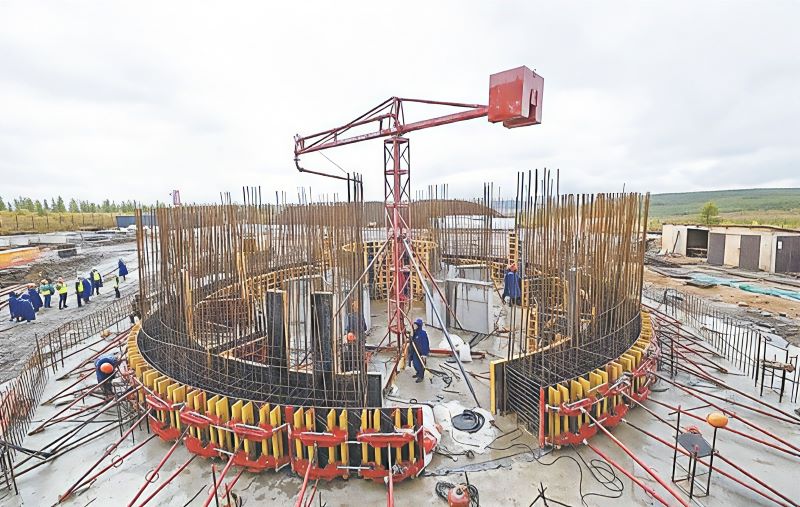
One year ago, the first batch of concrete was poured for the foundation of this unique instrument. Now, the outline of the future telescope is clearly visible, and the scale of construction is impressive. Despite unfavorable weather conditions, construction work is progressing intensely.
“The construction progress is four months ahead of schedule,” said Fadeyev, deputy director of capital construction at the ISZF. “We make full use of the warm season for construction, as winter may slightly slow down the progress. At the same time, we strictly control the construction process, engineering standards and the quality of building materials. There is our own laboratory on-site, and regulatory authorities also conduct regular inspections. The seismic intensity here reaches 8 to 9 degrees, so we have taken all measures to ensure structural stability, including additional reinforced structures. Protective expansion joints can maintain structural stability when the crust moves.”
The area has a seismic intensity of 8 to 9 degrees. Measures have been taken to ensure structural stability, including additional reinforced structures and protective expansion joints that maintain stability during crustal movements.
Over the past year, all foundation pouring at the site has been completed, and the semi-basement level is nearly fully built. Construction of the technical floor in the third section is currently underway. The construction team plans to complete all pipeline laying and earth backfilling before winter.
Inside the future administrative and experimental building, reporters viewed the reinforced foundation built for the 30-meter-high telescope tower. The foundation is poured on the most solid rock formation using high-strength concrete.
Academician Zhelebzov, scientific director of the Russian Academy of Sciences’ National Solar-Terrestrial Physics Complex, expressed satisfaction with the construction progress but noted that scientists and construction personnel now face new tasks.
“We must ensure construction proceeds as scheduled and in line with plans,” he said. “Another task of this visit is to determine the installation methods and sequence of the instruments, and clarify the construction timeline for the telescope’s mirror. The general manager of the Letkarino Optical Glass Factory, Alexander Ignatov, visited the site with us. We will also discuss technical solutions, as the mechanical structure here is very complex.”
Core Components of the Telescope
The Large Solar Telescope (KST) is a complete optical system, and all components, including the 3-meter primary mirror, will be manufactured by the Letkarino Optical Glass Factory.
“The factory has rich experience in manufacturing large-scale high-precision components,” said Ignatov. “Over the past 30 years, we have won many tenders in this field, including international ones, and produced more than 100 such components. The optical elements we make are installed in many telescopes, covering almost every continent.”
The KST-3 optical system includes approximately 30 components, and the factory is currently researching technical issues related to project implementation. The manufacturing of the telescope’s primary mirror will take three to four years. The challenge lies in its non-spherical shape—a highly complex curved surface. The processing accuracy of the theoretical curved surface can reach the nanometer level.
Ignatov and Academician Zhelebzov and his colleagues share common ground not only because they have known each other for a long time, but also because the ISZF is not only the project owner but also the general contractor for this major national scientific project.
“The KST-3 project originated from the ISZF,” Zhelebzov said. “The idea was proposed by Corresponding Member of the Russian Academy of Sciences Grigoryev, who works at our institute. The design of this instrument, as well as the entire National Solar-Terrestrial Physics Complex of the Russian Academy of Sciences, was also completed by our scientists. Our idea is becoming a reality, and we are certainly anxious. We keep looking for the right solutions and feel like pioneers. The responsibility is great, and we hope everything goes well for us!”
Completion Schedule and Supporting Facilities
The construction of the telescope is expected to be completed in 2030. By then, the staff size of the ISZF will double to 1,000 people.KST-3 is one of the seven facilities of Russia’s National Solar-Terrestrial Physics Complex. Two of these facilities—the Optical Instrument Complex and the Multi-Band Radio Heliograph—are already in use. Other facilities, including a lidar and radar complex, a heating bench, and a data processing center, will be completed by 2030.
According to the design, KST-3 will be installed on top of a 30-meter tower, placed on a rotating platform. The overall structure will be 42 meters high, the total weight of the telescope will be 120 tons, and the construction cost will be 36 billion rubles.
Another facility of the ISZF has passed the approval of the State Certification Authority. A laser radar complex will be built at the Baikal Observatory for Atmospheric Physics and Ecological Monitoring. It will be used to study the hard-to-reach upper atmosphere of the Earth and provide solutions to a series of issues in the field of global climate change.