

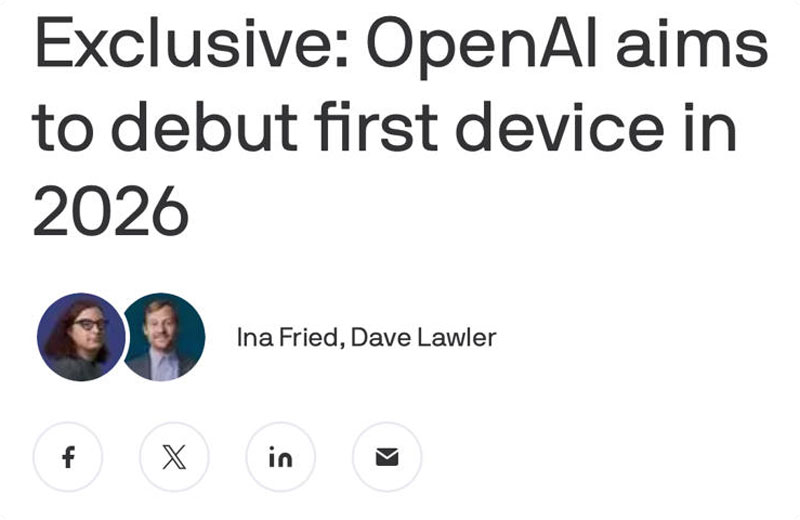
OpenAI to Launch First Hardware Device in 2026

At the globally watched Davos Forum, Chris Lehane, OpenAI’s Head of Global Affairs, revealed the latest news that the company plans to release its first hardware device in the second half of 2026. The announcement has drawn widespread attention from the tech industry, especially as AI and hardware integration continues to accelerate. The launch is seen as a major milestone in OpenAI’s future development.
Although Lehane did not explicitly confirm that the device will be released on schedule, he described the second half of 2026 as the “most likely timeframe.” He declined to provide any details, leaving the form and functionality of the device open to speculation. Since OpenAI acquired io, the company founded by former Apple Chief Design Officer Jony Ive, rumors about this AI device have been steadily growing.
According to multiple media reports, OpenAI is developing a small, screenless wearable device designed to interact with users in a more human-centered way. CEO Sam Altman has stated that the device will be “calmer” than a smartphone, and its minimalist design is expected to surprise users. This focus on simplicity and functionality may signal a new trend in future technology.
From a technical perspective, the device is expected to integrate advanced AI algorithms, potentially including voice recognition and natural language processing. The combination of these technologies will greatly enhance the user experience, making interactions with the device more natural and seamless. For example, users could control the device with simple voice commands to retrieve information or play music, offering a level of convenience likely to attract a broad audience.
In addition, reports indicate that OpenAI is also developing a specialized audio product, codenamed Sweetpea, which is expected to launch in September 2025, with first-year production reaching 40 to 50 million units. The product is seen as a potential alternative to Apple’s AirPods, with anticipated breakthroughs in both sound quality and functionality, further expanding OpenAI’s product lineup.
The launch of hardware devices is expected to create a new revenue stream for OpenAI, whose income currently relies primarily on user subscriptions. OpenAI CFO Sarah Friar predicts that the company’s annualized revenue in 2025 will exceed $20 billion, demonstrating strong growth potential in the AI sector.
Overall, OpenAI’s upcoming hardware device not only represents technological innovation but also reflects a deep understanding of user needs. As AI technology continues to advance, future devices are expected to become more than mere tools—they may become indispensable companions in daily life. In today’s rapidly evolving tech landscape, every move by OpenAI is worth watching.



Related Articles
Lorem ipsum dolor sit amet
Lorem ipsum dolor sit amet consectetur adipiscing elit. Quisque faucibus ex sapien...
Lorem ipsum dolor sit amet
Lorem ipsum dolor sit amet consectetur adipiscing elit. Quisque faucibus ex sapien...
Découvrez le monde passionnant de Nine Casinos : votre guide complet
Le secteur des casinos en ligne ne cesse de croître, offrant aux...
Découvrez comment la technologie révolutionne l’expérience des casinos en ligne
Avec plus de 60 % des joueurs français qui préfèrent désormais jouer...