
Dutch agricultural technology startup PATS has recently closed a €2.7 million seed funding round. This capital will be dedicated to accelerating the promotion and large-scale application of its automated, technology-driven intelligent pest management solutions, providing global growers with more efficient and sustainable pest control tools.
Funding Drives Core Mission Advancement
This funding round marks a key milestone for PATS in advancing its core mission: replacing traditional chemical pesticides with intelligent technologies aligned with biological principles. Traditional pesticides not only easily cause soil and water pollution but also may lead to pest resistance with long-term use, weakening control effectiveness. PATS’ technology, by integrating scientific innovation and biological insights, is committed to breaking this predicament.
The seed round is backed by a consortium of investors including Division Q, Percival Participations, Delft Enterprises, and multiple players in the technology and horticulture sectors. These investors combine experience in technological innovation and agricultural industry insights, injecting not only capital into PATS but also providing industry resources and market perspectives to help optimize its solutions for diverse global growing environments.
Currently, global growers face three core challenges. First, rising pest pressure due to climate warming and abnormal rainfall has expanded pest habitats and increased infestation frequency. Second, countries worldwide are imposing stricter regulations on chemical pesticide use to protect the ecology and public health. Third, the agricultural sector is suffering from a shortage of skilled labor, making traditional manual pest monitoring unsustainable. PATS believes that automated real-time monitoring and control technologies are the key to addressing these issues. Such technologies can reduce chemical use to practice sustainable agriculture, lower reliance on manual work, and provide data-driven decision support for growers.
“ This funding is a crucial step toward realizing our vision of ‘biology and technology advancing in synergy’,” said Bram Tijmons, CEO and co-founder of PATS. “For too long, growers have had to compromise between effective pest control and sustainable farming, or between labor costs and solution reliability. Our goal is to eliminate this trade-off, and this investment brings us closer to that objective.”
AI-Powered Pest Management Product Portfolio
PATS’ core strength lies in converting real-time pest data into precise actionable recommendations, supported by advanced data analysis and automation technologies. By collecting data on pest activity, population changes, and environmental conditions, growers can intervene in pest control earlier and improve the effectiveness of their measures. For pests that are difficult to control solely through biological methods (such as certain moth and flying insect species), PATS is also developing bionic tools, such as drones that simulate bat behavior—leveraging bats’ natural deterrent effect on pests to achieve precise control without chemical intervention.
The funds from this round will be specifically used to develop and promote PATS’ full range of AI-driven pest management products, covering the entire pest control process:
- PATS-C: Focuses on real-time tracking of flying pests in greenhouse environments. It uses sensors and imaging technology to monitor pests 24/7 and sends instant alerts once pest populations reach the early warning threshold, facilitating rapid intervention.
- Trap-Eye™: Co-developed with Biobest, a leader in the biological control sector, it enables automated monitoring of sticky insect boards. Replacing manual counting, it uses image recognition technology to count pests in real time and transmit data, improving monitoring efficiency and accuracy.
- PATS-Vinder: A forecasting algorithm based on moth activity. By analyzing the flight patterns of moths (which reflect mating and egg-laying behaviors), it predicts the hatching time of caterpillars, allowing growers to take preventive measures in advance.
- PATS-Kalendar: A digital Integrated Pest Management (IPM) logbook that links pest data with control measures. It helps growers track the effectiveness of different solutions, summarize pest patterns, and optimize subsequent strategies.
- PATS-X: An automated drone system that can accurately eliminate moths in the air, block their reproduction chain, reduce the number of caterpillars and crop losses, and significantly lower the dependence of greenhouse crops on chemical pesticides.
These systems work in synergy to form an integrated intelligent solution. It not only supplements the effectiveness of biological control and reduces chemical use but also lowers the need for manual inspections, providing growers with timely early warnings and reliable decision support.
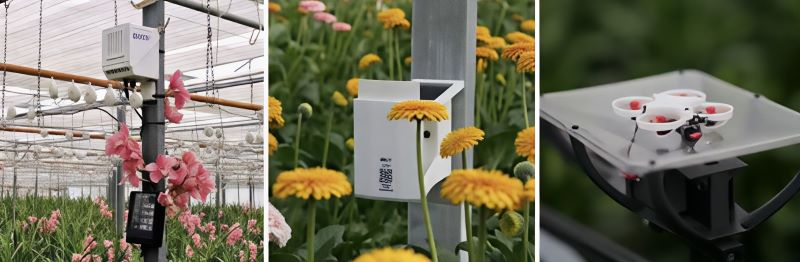
Current Application and Production Capacity
At present, PATS’ technologies have served hundreds of growers in more than 25 countries worldwide, widely used in the protection of vegetables (such as tomatoes and peppers), flowers (such as roses and lilies), and ornamental plants. Against the backdrop of increasingly strict global sustainable agriculture standards, PATS’ solutions help growers meet environmental requirements while ensuring crop yields and profits, becoming a key enabler in the global supply chain.
All of PATS’ hardware and software are independently developed and produced in Delft, the Netherlands. The local factory currently has a monthly production capacity of over 1,000 sensor systems. This localized production model not only ensures strict product quality control but also allows PATS to quickly respond to feedback from global growers, adjusting products according to pest species and climate conditions in different regions to ensure adaptability.
Post-Funding Development Focus
With this round of funding, PATS has identified three key development directions:
- Accelerate Technological R&D: Optimize AI algorithms to improve the accuracy of pest identification and prediction, upgrade hardware performance (such as extending drone battery life and enhancing sensor sensitivity), and explore more bionic pest control tools.
- Expand Global Layout: Adapt solutions to more high-value crops such as fruits and herbs, and focus on developing markets in Asia (where demand for protected agriculture is strong) and Latin America (where agriculture is diversified and emphasizes sustainable development). Through cooperation with local distributors and research institutions, it will adapt to regional growing environments and regulations.
- Optimize User Experience: Simplify software interfaces, create multilingual training materials and video tutorials, and establish a dedicated customer service team to help growers with weak technical foundations easily use the products, making advanced pest management technologies accessible to a wider audience.
PATS is optimistic about its future development and is committed to building an agricultural ecosystem where technology and nature coexist harmoniously, enabling global growers to effectively address pest challenges with intelligent and sustainable tools.