

Neuralink: Voice Conversion Trial to Kick Off in October

Neuralink, the brain-computer interface (BCI) company owned by Elon Musk, recently announced that it will officially launch a groundbreaking clinical trial in the United States in October. The core goal of this trial is to directly convert human thoughts into text output, building a communication bridge for patients who have lost the ability to speak. This progress is attributed to the experimental device exemption qualification newly granted by the U.S. Food and Drug Administration (FDA), which allows the company to conduct clinical verification on innovative devices that have not yet been approved.
“If you imagine saying something, we can capture it,” emphasized Neuralink President DJ Seo in an interview. The new trial will focus on the direct reading of speech signals from the brain. It will capture human “words in the mind” through an implanted device and then decode them into recognizable text via AI algorithms. This technical path has already been verified in preliminary research. Previously, Brad Smith, a patient who lost the ability to speak and move due to amyotrophic lateral sclerosis (ALS), successfully typed using his brain with the help of a Neuralink implant. He could even control a cursor to play video games with his thoughts, and the smoothness of his operations far surpassed that of traditional eye-tracking devices.
Technological Advantages Lead the Medical Industry
As a leading enterprise in the BCI field, Neuralink’s core competitiveness stems from the unique design of its invasive device: 1,024 electrodes are distributed on 64 filaments only 4-6 microns wide, and a dedicated R1 robot completes the implantation into the motor cortex of the brain within 15 minutes. This design not only minimizes damage to brain tissue but also enables high-precision signal capture. Compared with non-invasive devices such as electroencephalography (EEG), this design increases the signal-to-noise ratio by several times, effectively avoiding signal attenuation caused by the skull, and its information transmission rate is sufficient to support real-time interaction needs.
Currently, this technology has demonstrated clear value in medical scenarios. For groups of patients with neurodegenerative diseases such as stroke sequelae and ALS, BCI devices serve as “thought transmitters.” Even if patients cannot control the movement of their mouths to speak, the implanted device can still capture the speech coding signals in the motor cortex of their brains and directly transmit them to computer terminals for conversion into text or synthetic speech. Earlier this month, Neuralink also completed its first overseas implantation surgery in Canada. Two paralyzed patients around the age of 30 successfully controlled external devices with their thoughts, laying a solid foundation for the clinical promotion of the technology in the North American market.
Aiming for the Consumer Market
While continuing to make breakthroughs in medical applications, Neuralink is accelerating its penetration into the consumer market. Seo clearly revealed at an event held by the Korea Advanced Institute of Science and Technology in Seoul that the company plans to launch implant tests of the device on healthy people within 3-4 years, with the ultimate goal of realizing the launch of consumer-grade applications by 2030. This plan marks a key shift in the BCI industry from “medical rehabilitation” to “human enhancement,” breaking the current industry limitation of only serving critically ill patients.
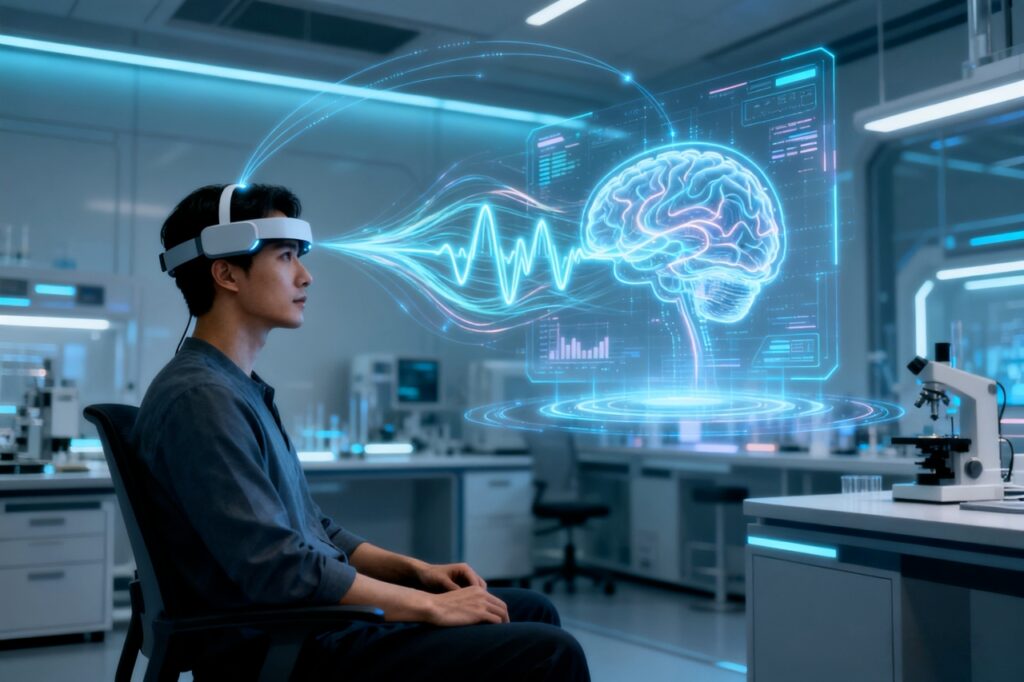
The future scenario depicted by Seo is highly imaginative: users will no longer need traditional interaction methods such as keyboards and voice. Instead, they can directly communicate with AI platforms like large language models (LLMs) through their thoughts, and the response speed will even exceed the speed of normal speech. This “thought-level interaction” will not only reshape the human-computer interaction model but also potentially spawn brand-new ways of information acquisition, creation, and social interaction. For instance, designers can directly output creative sketches through their thoughts, students can complete knowledge-based Q&A at the speed of thinking, and business professionals can achieve millisecond-level cross-language thought synchronization—all of which align with the AI new trend of deeper integration between human intelligence and artificial intelligence.
Neuralink’s voice trial and its transition to the consumer market not only pose new propositions for global BCI governance but also represent an important milestone in the AI technology revolution.



Related Articles
Ritzo Casino – Quick‑Fire Slots and Rapid Wins for the On‑The‑Go Player
1. Γιατί το Ritzo λάμπει για σύντομο, υψηλής έντασης παιχνίδι Φανταστείτε να...
Bet On Red: Tragamonedas de Juego Rápido, Acción en Vivo y Bonos Relámpago
1. El Pulso de Fast‑Track Gaming Bet On Red está diseñado para...
Coolzino – The Ultimate Quick‑Hit Casino Experience
Welcome to Coolzino – Fast‑Track Gaming in a Blink Coolzino brings a...
Lucky Vibe Casino: Quick Wins and High‑Intensity Play for the Modern Gambler
When you’re looking for a place where every spin feels like an...