

DeepSeek-R1 Graces Nature Cover

The open-source artificial intelligence field has witnessed a major breakthrough. The DeepSeek-R1 research paper has been featured as the cover article in the prestigious international journal Nature, marking the first time a mainstream large language model (LLM) has undergone scientific community scrutiny through the peer-review mechanism. This research, completed by the team of DeepSeek’s founder and CEO, Liang Wenfeng, proposes a new paradigm that uses pure reinforcement learning (RL) to stimulate the model’s reasoning capabilities. It demonstrates performance surpassing traditional training methods in graduate-level tasks within mathematics, programming, and STEM fields.
Breaking through conventional thinking, the research team suggested that human-defined reasoning patterns might limit the model’s exploration space. Through unrestricted reinforcement learning training, DeepSeek-R1 naturally evolved complex reasoning behaviors—including verification, reflection, and strategy adjustment—without the need for manually annotated reasoning processes. Experiments show that this model tends to generate longer responses when solving mathematical problems, incorporating multi-step verification and exploration of alternative solutions, significantly outperforming traditional models reliant on human-annotated methods like Chain-of-Thought (CoT).
On the technical implementation front, the research team proposed the “Group Relative Policy Optimization” (GRPO) algorithm, constructing a multi-stage training pipeline: starting from the base model DeepSeek-V3 Base, and progressively optimizing through rejection sampling, RL training, and supervised fine-tuning to produce four intermediate versions (R1-Zero to R1-Dev3) and the final model. Among these, R1-Zero exhibited raw reasoning ability but suffered from issues like poor output readability; subsequent versions improved general language generation capabilities while maintaining reasoning advantages by incorporating non-reasoning corpora and code engineering data.
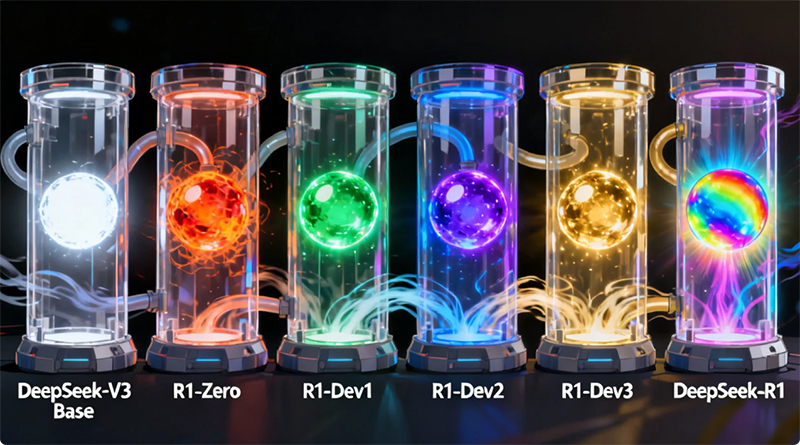
Across 21 mainstream benchmarks, including authoritative evaluations like MMLU, GPQA Diamond, and AIME 2024, DeepSeek-R1 comprehensively outperformed traditionally trained models. Particularly in math competition-level tasks, its performance approached that of human experts. The research also found that the reasoning patterns stimulated by the RL framework are transferable and can be used to enhance the reasoning capabilities of smaller models, offering new ideas for model compression techniques.
This achievement has received high praise from academia. Carnegie Mellon University Assistant Professor Daphne Ippolito noted that DeepSeek-R1 achieves a transition from a “powerful but opaque problem solver” to an “understandable, trustworthy human-like conversational system,” meeting core human needs for AI tools. In an editorial, Nature emphasized that this is the first peer-reviewed research on a mainstream LLM. Eight domain experts conducted rigorous reviews of the model’s originality, methodology, and robustness, with relevant reports and author responses published simultaneously, setting a transparency benchmark for the industry.
Addressing issues like data bias and model security prevalent in the AI industry, the review process played a crucial balancing role. For instance, after reviewers pointed out the lack of detailed safety testing in the original paper, the research team added a dedicated section systematically comparing the safety protective capabilities of DeepSeek-R1 with competing models. As an open-weight model, its safety directly impacts the developer community and public interest; this external oversight mechanism effectively prevents benchmark manipulation practices like “self-scoring.”
Nature calls for more AI companies to submit their models for independent review, stressing the importance of “supporting technical claims with evidence.” Against the backdrop of surging industry investment and intensifying competition, this research, through scientific validation mechanisms, provides a practical example for curbing excessive hype and establishing technical credibility. As the latest news in AI development, DeepSeek-R1 has garnered 91.1k stars on GitHub, and its technical approach is attracting widespread attention and secondary development within the global developer community.



Related Articles
What Makes Modern Online Casinos So Popular
What Makes Modern Online Casinos So Popular Online casino sites have become...
Lorem ipsum dolor sit amet
Lorem ipsum dolor sit amet consectetur adipiscing elit. Quisque faucibus ex sapien...
Lorem ipsum dolor sit amet
Lorem ipsum dolor sit amet consectetur adipiscing elit. Quisque faucibus ex sapien...
Lorem ipsum dolor sit amet
Lorem ipsum dolor sit amet consectetur adipiscing elit. Quisque faucibus ex sapien...