

China’s Wind Power Industry: From Wind Chaser to Global Leader
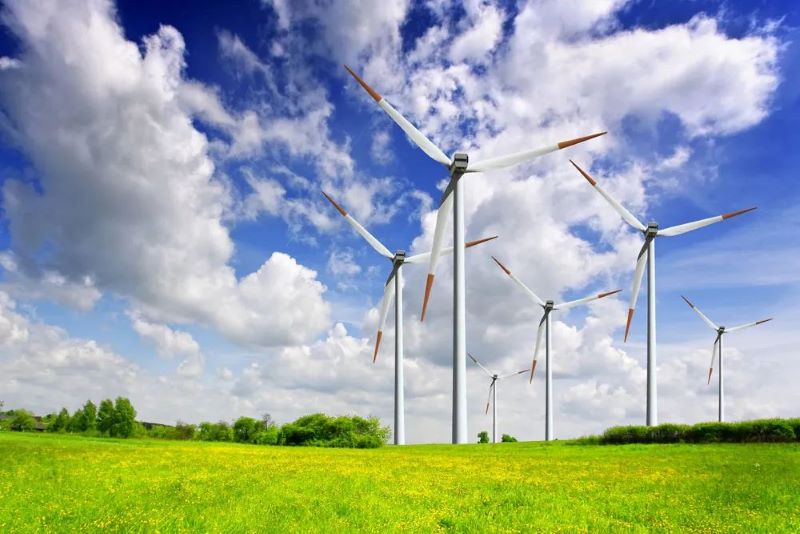
Hundred-meter-tall white windmills stand majestically across the Gobi Desert, drones autonomously inspect offshore wind turbine blades along the coastline, and artificial intelligence algorithms optimize the power output of wind farms in real time… These high-tech scenes are a true reflection of what China’s wind power industry will look like in 2025.
On September 23rd, local time, at the United Nations General Assembly, US President Trump’s claim that “China manufactures a lot of wind turbines, ships them around the world, but uses almost none of them” quickly drew global attention to China’s wind power industry.
The US claim is untrue. Objective data such as China’s installed capacity, technological achievements, and global market share bear witness to its development trajectory. Against the backdrop of the world’s joint response to climate change, Chinese wind power facilities around the world demonstrate China’s contribution to the global energy transition.
A 1,500-fold Growth: From 340,000 kW to 521,000 kW
China’s wind power industry began in the 1980s. After decades of development, it has achieved a historic leap from technology importation to independent innovation. Compared to a mere 340,000 kW in 2000, China’s installed wind power capacity reached 521,000 kW in 2024, a more than 1,500-fold increase. In 2020, newly installed wind power capacity surpassed thermal power for the first time; by 2024, newly installed wind power capacity was 1.5 times that of thermal power. According to data from the National Energy Administration, China’s cumulative installed offshore wind power capacity reached 43.31 GW in 2024, a year-on-year increase of 14.9%, maintaining its global lead for the fourth consecutive year. Of this total, newly installed offshore wind power capacity reached 5.62 GW, ranking first globally for the seventh consecutive year, continuing to lead global offshore wind power development.
Power generation is the most convincing indicator of wind energy’s actual utilization efficiency. By 2024, China’s wind power generation will approach the 1 trillion kilowatt-hour mark, reaching 991.6 billion kilowatt-hours, a year-on-year increase of 16%. Back in 2010, wind power generation was 44.6 billion kilowatt-hours, accounting for just over 1%. Over the past decade, not only has power generation achieved a nearly 20-fold leap, but the 95.9% average utilization rate in 2024 also underscores wind power’s evolution from a supplementary energy source to an efficient and reliable mainstay power source.
Accounting for 68.2% of the world’s total: Nearly two out of every three new wind turbines will be installed in China.
According to the Global Wind Energy Council (GWEC) annual report released in April this year, China will install 79.8 gigawatts of new wind power capacity in 2024, accounting for 68.2% of the global total, becoming the primary driver of global wind power market growth. By the end of 2024, China’s total installed wind power capacity will reach 521 million kilowatts, accounting for 45.8% of the global total. This figure means that for every three new wind turbines installed worldwide, nearly two will be installed in China.
The development of China’s wind power industry has also injected strong momentum into the global energy transition. Currently, Chinese-made wind turbines are exported to over 40 countries worldwide. In Argentina’s Patagonia, Chinese-made low-temperature wind turbines have helped reduce local wind power development costs by 30%. At the Adama Wind Farm in Ethiopia, Chinese-built projects provide stable electricity to two million residents. These projects not only bring clean energy but also share Chinese technology and development experience.
More than six times, 3.6 billion kilowatts: China’s future holds “unlimited wind and solar power.”
On September 24, General Secretary Xi Jinping announced China’s new round of Nationally Determined Contributions in his address to the United Nations Climate Change Summit: By 2035, China’s economy-wide net greenhouse gas emissions will be reduced by 7%-10% from their peak, with the goal of achieving even higher levels. Non-fossil energy consumption will account for over 30% of total energy consumption, and the total installed capacity of wind and solar power generation will more than six times that of 2020, aiming to reach 3.6 billion kilowatts.
Renewable energy industry media outlet “Recharge” reported on the 24th that China is “far ahead” in the world in wind farm installations. Certain statements about China’s wind power sector seriously contradict the industry’s basic technological facts and development status.
In response to the claim that “China itself uses almost no wind power equipment,” Italian scientist Fei Fan from the Chinese Academy of Sciences’ Research Center for Eco-Environmental Sciences strongly refuted the claim with personal experience. He told Science and Technology Daily that efficient wind turbines can be seen everywhere along the high-speed rail line from Beijing to Jinan. China is not only the world’s largest manufacturer of wind power equipment, but also one of the largest users.
Professor Terels Skrydstrup of Aarhus University in Denmark, recipient of the China Government Friendship Award, noted, “No other country is promoting sustainable development in such an all-encompassing manner as China. In the fields of solar and wind energy, China has become a true technological benchmark. Wind turbines are a vital tool for combating climate change, far more than some have claimed.”
From the Qinghai-Tibet Plateau to the shores of the East China Sea, from technology introduction to innovation leadership, China’s wind power industry is demonstrating its approach to green development to the world with concrete data and achievements. In the shared mission of addressing global climate change, China’s wind power industry will continue to spin its blades, injecting a steady stream of green power into the world.


Related Articles

Local Moves for Clean Energy’s Spatial Impacts
January 26 marks the International Day of Clean Energy, an initiative raising...

US $12 Billion Treasury Plan Struggles to Break the Deadlock in Critical Minerals
On February 3, 2026, US President Donald Trump announced the launch of...

IEA Latest Forecast: Renewables and Nuclear to Supply Half of Global Electricity by 2030
According to the latest report released by the International Energy Agency (IEA),...


Czech Republic Shuts Down Its Last Hard Coal Mine
In January 2026, the Czech Republic officially closed its last deep-well hard...